


The average payout for pedestrian hit by car is never one fixed number. That is the first thing readers need to understand. Published estimates often place pedestrian accident settlements anywhere from about $10,000 to $500,000, while catastrophic cases can go much higher. One widely cited law firm analysis places the average at about $67,511.90 and the median at $30,000, while other published legal sources warn that there is no single national benchmark because injury severity, fault, and insurance policy limits change everything. That is why the better question is not just what the average payout is, but what factors shape the payout for a pedestrian in a real case.
Pedestrian crashes are also serious by nature. NHTSA reports that in 2023, 7,314 pedestrians were killed and more than 68,000 were injured nationwide. That helps explain why so many claims involve serious injuries, long recovery periods, and large losses tied to work, mobility, and ongoing care. Even when someone survives, the difference between minor injuries and life changing harm can turn a modest claim into a very large one.
“At some point in the day, everyone is a pedestrian.”
That short line from NHTSA captures why these cases matter. A person does not need to be doing anything unusual to be exposed to risk. They may be crossing near traffic signals, walking in a parking lot, or simply moving through a crosswalk when they are hit by a car.
Pedestrian Accident Settlements and the Average Settlement Range
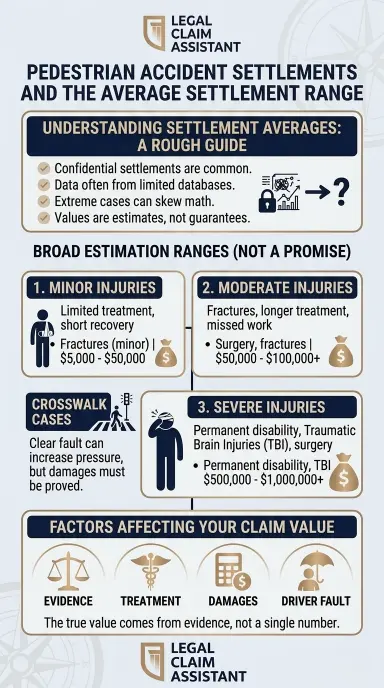
When people search for pedestrian accident settlements, they usually want a number fast. The problem is that settlement data is messy. Many settlements are confidential, many online averages come from private case databases or law firm marketing pages, and the most extreme cases can distort the math. That is why I would frame every average settlement as a rough guide, not a promise. Still, broad ranges are useful if you explain them honestly.
Published estimates often suggest that a straightforward pedestrian accident claim involving minor injuries, limited treatment, and short recovery may settle between roughly $5,000 and $50,000. Moderate cases can move much higher, especially when they involve fractures, longer treatment, missed work, or a stronger proof package. Severe cases involving surgery, permanent disability, spinal cord injuries, or traumatic brain injuries can exceed $500,000 and sometimes reach seven figures. Some sources also note that a crosswalk settlement average often falls in a higher range than very minor claims because clear fault can increase pressure on the insurer.
That does not mean a crosswalk case is automatically valuable. A pedestrian hit by car still has to prove damages. The final settlement amount depends on how badly the injury affects daily life, how much treatment was needed, whether the at fault driver had enough insurance coverage, and whether the injured person shares any fault. In other words, the real value of a pedestrian accident comes from evidence, not from one average pulled out of context.
Pedestrian Injury Settlements for Minor Injuries and More Serious Injuries
The factor that most strongly tends to affect pedestrian injury settlements is injury severity. That is why it makes sense to break pedestrian injury settlements into practical categories rather than pretend every case fits one box. Claims involving bruises, sprains, or short term soft tissue injuries usually land at the lower end of the spectrum. They can still matter, especially if the injured person needed imaging, follow up care, or missed work, but these cases are not valued the same way as claims involving permanent harm. Published estimates commonly place these smaller cases in the $5,000 to $50,000 range.
Once a case involves broken bones, surgery, physical therapy, nerve damage, or a long period of pain, the number starts to change. A fractured leg, damaged shoulder, or back injury can push the claim much higher because treatment is more expensive and recovery takes longer. Then there are the truly high value cases. More serious injuries such as spinal cord damage, major orthopedic trauma, and traumatic brain injuries can create a claim for past and future care, lost earning ability, permanent pain, and a major shift in daily function. Those are the files that often drive settlements well above the ordinary average pedestrian accident settlement.
The personal impact matters just as much as the diagnosis. An injury that heals on paper may still leave lasting weakness, restricted movement, physical pain, or emotional distress. That is why two people with the same label on a medical chart can have very different results. The better question is not just what the injury is called, but how the injury affects work, sleep, family life, walking, driving, and independence. That is what moves a claim from ordinary to significant when a pedestrian is hit by a car.
Medical Costs, Insurance Coverage Limits, and Pedestrian Accident Compensation
Most pedestrian accident compensation is built from damages, and damages start with money losses. Medical expenses are usually the largest category. A serious pedestrian collision can create ER bills, hospital bills, imaging, surgery, medication, rehab, assistive devices, and months of follow up care. For some people, the real issue is not only current bills but future medical care, future surgery, or future medical bills that continue long after the insurer wants to close the file. When a person has permanent mobility limits or chronic pain, future medical expenses and future medical needs become a central part of the value analysis.
The second major category is income loss. If the injured pedestrian misses work, the claim may include lost wages. If the injury causes long term work restrictions, the file may also include reduced future earning capacity. The third category is non economic loss, such as pain and suffering, emotional distress, inconvenience, and the day to day burden of recovery. In rare cases involving extreme recklessness, a claim may also seek punitive damages, though those are not available in every case and should never be assumed.
Even a strong case can still run into a hard ceiling, insurance coverage limits. If the driver’s insurance coverage is low, a very serious claim may still be capped by the amount of available coverage unless there are other policies or defendants to pursue. That is why insurance coverage matters so much. Washington’s insurance regulator explains that uninsured motorist coverage or underinsured motorist coverage can help pay for injury and damage after a hit and run or when the other driver lacks enough insurance. That can be critical in a pedestrian case where the harm is severe but the policy behind the at fault driver is small.
Injury level | Typical published range | What usually drives the number |
|---|---|---|
Minor injuries | $5,000 to $50,000 | Limited treatment, brief recovery, small wage loss |
Moderate injuries | $50,000 to $150,000 or more | Fractures, longer care, stronger proof of loss |
Severe injuries | $150,000 to $500,000 plus | Surgery, permanent limitations, high medical costs |
Catastrophic injuries or wrongful death | Can exceed $1 million | Lifelong care, profound loss, major income impact |
These are guide ranges drawn from published legal sources, not guaranteed outcomes.
Pedestrian Accident Case, Fault, and Legal Representation for Maximum Compensation
A pedestrian accident case rises or falls on liability. You can have large injuries, but if the proof of fault is weak, the insurer will use that weakness against you. That is why the first goal in any injury claim is to show clearly what happened and why the driver was responsible. A strong file may include scene photos, witness statements, surveillance footage, police reports, vehicle damage, roadway markings, and details about lighting or traffic signals. If the driver was speeding, texting, or distracted, those facts may support a stronger case built around driver’s negligence and distracted driving.
State fault rules also matter. Some states use pure comparative fault. Others use modified comparative fault. Justia’s 50 state survey explains that in comparative negligence systems, a plaintiff’s recovery can be reduced by their share of fault, and in many modified systems recovery is barred once fault reaches a certain threshold. That means an injured party may still be able to recover compensation even if they were partly at fault, but the value of the claim can drop sharply.
This is one reason legal representation can matter so much. An experienced pedestrian accident lawyer or personal injury lawyer can help organize evidence, address bad assumptions, value all damages, and push back when insurance companies try to assign blame too aggressively. A strong law firm also knows how to frame the case around liability, losses, and future harm rather than letting the insurer define the story. If your goal is maximum compensation, proving fault clearly is just as important as proving the medical harm. A weak liability story can shrink even a serious injury case. A strong one can support a far better fair settlement.
What To Do After a Pedestrian Hit by Car to Build a Strong Pedestrian Accident Claim
If you were pedestrian hit by a vehicle, the first steps matter more than most people think. Start with immediate medical attention. Even if symptoms seem manageable, you should get checked right away. Early care protects your health and creates a record that ties the injuries to the crash. For a pedestrian hit by car, delay gives the insurer room to argue that the injury came from something else or was not serious enough to justify a large claim. That is why prompt medical attention and follow up medical treatment are so important.
Next, preserve evidence. Take photos of the accident scene, crosswalk markings, nearby businesses, broken glass, vehicle position, visible injuries, shoes, clothing, and road conditions. Get names and numbers for witnesses. Ask how the crash will be documented and request a copy of the official report later. Good police reports and photos can become some of the strongest tools in building a strong pedestrian accident claim. Keep every record, discharge papers, prescriptions, receipts, mileage, wage information, and notes about how the injuries affected daily life.
Then be careful with the insurer. Early contact from insurance companies often feels routine, but it can shape the claim. Give basic facts if required, but do not guess, minimize symptoms, or rush into a settlement before you understand the full picture. A low early offer may look tempting when medical bills are already arriving. Still, a fast check is not the same thing as fair compensation. If there is any sign of lasting harm, missed work, or disputed fault, talk to an experienced attorney or ask for a free consultation before deciding how to proceed. The goal is not just to get paid fast. It is to pursue compensation that reflects the real harm caused when you were hit by car.

How an Experienced Pedestrian Accident Lawyer Helps You Pursue Compensation
Many people start out thinking they can handle the claim themselves, especially when fault seems obvious. Sometimes that works in a very small case. But once the injuries are real, the value is uncertain, or the insurer starts pushing back, the gap between a simple claim and a properly developed case becomes obvious. An experienced pedestrian accident lawyer looks beyond the obvious bills. They assess all losses, build the record, identify weaknesses, and push for a settlement that reflects not just what has already happened, but what the injury will keep costing. That is how good counsel helps clients pursue compensation and not just accept the first number on the table.
This matters because pedestrian cases often involve more than one moving part. There may be disputed fault, limited driver’s insurance coverage, unclear witness accounts, or injuries that worsen over time. A good lawyer helps connect treatment records to the crash, show how the injury changed work and daily life, and explain why certain losses should count. That includes current bills, future medical, long term rehab, transportation costs, home modifications in extreme cases, and the effect on routine life. In the most serious files involving catastrophic injuries, spinal cord injuries, or permanent cognitive deficits, the claim must often be built around lifetime impact rather than short term recovery.
A personal injury lawyer also changes the way negotiations are handled. Instead of reacting to the insurer’s timeline, the claim can be presented with a structured demand, clear liability proof, and a stronger damages analysis. That often creates better leverage for a pedestrian settlement. It does not guarantee a result. Nothing does. But if the goal is to recover compensation, protect future losses, and fight for a fair settlement, skilled legal representation usually improves how the case is prepared and valued. That is why many firms offer a free consultation at the start. It gives the injured pedestrian a chance to understand the strengths and risks of the claim before making a decision.
You Deserve Justice. Let Us Help.
Speak with a trusted Pedestrian Accident lawyer who will stand by your side, protect your rights, and fight for the compensation you deserve.
No Win, No Fee. Let the Best Pedestrian Accident lawyers Fight for your Compensation!

Under 1 Minute

100% Free

Expert-Reviewed

Private & Secure
© 2025 Legal Claim Assistant. All Rights Reserved.
Terms of Service | Privacy Policy | Contact Us | Marketing Partners
Related Article
Share this article:


