


 Fact Checked By Our Attorneys
Key Takeaways:
- Motor vehicle accident claims are typically available only if you were not at fault or were a passenger and the accident caused real injuries or damages.
- Medical assessment or treatment within two weeks of the accident is a critical factor and follow up care strongly affects eligibility.
- Valid claims usually require supporting documentation such as a police report or insurance information from the at fault driver or uninsured motorist coverage.
- Claims are limited by time and location and generally must fall within the last 12 months and meet state specific requirements.
- Legal Claim Assistant helps accident victims quickly determine if they meet these criteria and connects eligible claimants with the right attorney for a free case review.
What Is a Motor Vehicle Accident?
A motor vehicle accident is any incident where a motor vehicle causes injury, death, or property damage. This includes a car accident, truck crash, motorcycle incident, or a major collision involving pedestrians or passengers.
Every year, thousands of motor vehicle crashes result in serious injuries or motor vehicle deaths, leaving families to navigate complex legal hurdles. Legal Claim Assistant specializes in helping those affected by motor vehicle fatalities seek the justice they deserve.
Legally, the term goes beyond everyday language. What feels like a simple auto accident can still qualify as a motor vehicle accident under the law if injuries occurred. Even low speed impacts may count when medical treatment is needed.
Motor vehicle collisions include rear end crashes, intersection impacts, and crashes caused by impaired driving. Serious cases may involve fatal motor vehicle crashes, where surviving family members may have separate legal rights.
The key factor is not how dramatic the crash looked. It is whether a motor vehicle was involved and whether injuries or losses resulted from that event.
Common Types of Motor Vehicle Accidents
How Do Motor Vehicle Collisions Happen?
Motor vehicle collisions happen in many everyday situations. Most follow clear patterns seen by police and emergency services across the country.
Rear end crashes
Often caused by distracted driving, phone use, traffic congestion, or limited stopping distance. The other driver usually fails to react in time.
Intersection collisions
These occur when a driver ignores signals, misjudges speed, or fails to yield. Many crashes at intersections involve high severity due to impact angles.
Highway incidents
High speeds increase risk and severity. Sudden braking, poor vehicle maintenance, engine failure, or unsafe lane changes often play a role.
Pedestrian and passenger involvement
Pedestrians and bicycle riders are vulnerable on the roadway. Passengers can be injured in the same way as drivers even when wearing a seat belt.
In most cases, police use the report, location, circumstances, and statements to determine how the collision happened and who was responsible.
Motor Vehicle Accident Injuries and Long Term Impact
Motor vehicle accidents often result in personal injury that goes beyond immediate pain. Many people are injured in ways that affect daily life long after the crash.
Physical injuries can include fractures, soft tissue damage, head trauma, and injuries that require repair or ongoing support. Some symptoms appear days or weeks later, especially after high severity crashes.
Delayed effects may impact work, mobility, and access to normal activities. Medical costs can continue to grow over time, even when initial treatment seemed limited.
Psychological effects are also common. Anxiety, sleep problems, and fear of traffic can affect recovery. The extent of these impacts is often considered when claims are reviewed by an insurer or court.
Motor Vehicle Deaths and Fatal Accident Claims
Motor vehicle deaths remain a leading cause of fatal injury according to data from the national center for traffic safety. A fatal motor vehicle accident can lead to a claim when the death was caused by the actions or operation of another person or object on the road.
A claim may be possible when an investigation shows that another party was responsible. This may involve unsafe driving behavior, failure to follow traffic laws, or a lack of proper vehicle safety. The likelihood of a valid claim depends on the definition of fault insurance coverage and whether the loss is legally covered.
Eligible parties are often close family members or a legal representative who can act on behalf of the person who died. They may be able to file a claim to address losses and support needs compared to what the family would have had otherwise.
Time limits matter. In many cases, including some in Texas, claims must be filed within one year. Each situation depends on the circumstances and the coverage involved.
What To Do After a Car Accident?
- Make sure everyone is safe
Check yourself and every other person involved. Move to a safe location if possible and wait for assistance. - Contact emergency services
Call for help so police can arrive and create an official record. Emergency services assist with safety and help prevent further risk. - Get medical evaluation
Even if your injuries seem minor, get checked. Some injuries are not obvious at rest and early evaluation matters. - Document the scene
Take photos of the vehicles, objects, roadway conditions, and damage. This helps establish what happened later. - Exchange insurance information
Collect insurance details from the other driver. This determines what coverage may apply and whether damages are covered. - Keep records
Save all documents estimates and reports. These records assist if you later file a claim or need to show what occurred.
These steps focus on safety protection and preserving your options without increasing risk or reducing your access to support later.
Motor Vehicle Accident Claims Explained
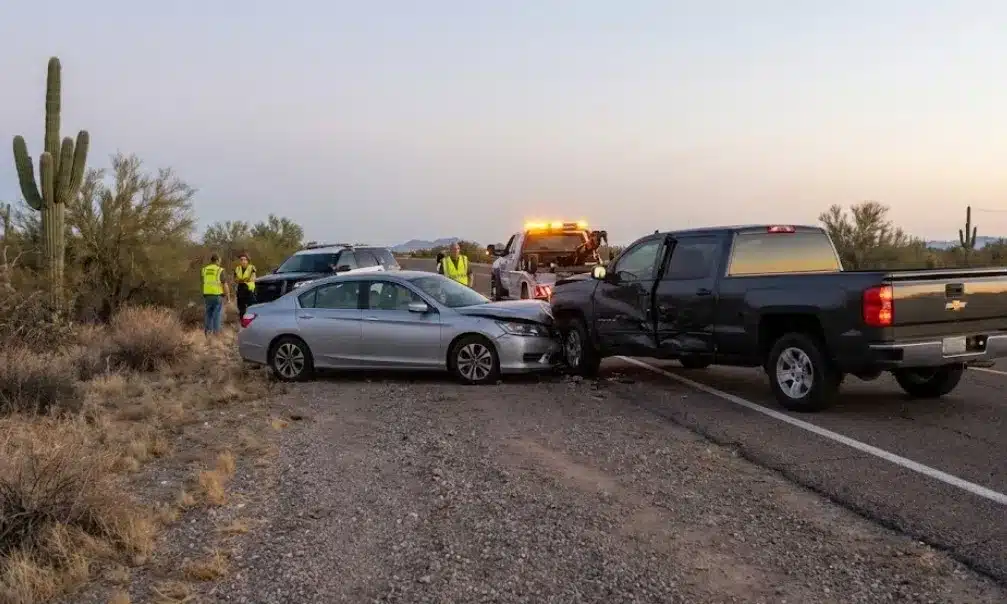
A motor vehicle accident claim is a formal request for compensation after motor vehicle crashes cause injuries, motor vehicle deaths, or property damage. These claims often follow motor vehicle collisions involving one or more vehicles, including incidents where a car strikes a parked vehicle. Because motor vehicle fatalities result in complex legal challenges, these claims require thorough documentation to ensure that the impact of the loss is fully recognized by insurance providers.
A claim may be filed by an injured driver, a passenger, or another person affected by the accident. In some cases, claims are also filed on behalf of drivers who were fatally injured in traffic collisions. The definition of a valid claim depends on how the accident occurred—whether it was caused by distracted driving or a failure to obey traffic signals—and whether the losses are covered by insurance. The legal process can help victims and families seek compensation after serious or fatal motor vehicle accidents on both busy highways and rural roads across the country.
Eligibility is usually based on a few core factors, such as fault, the timing of medical treatment, and the available documentation. The accident must have occurred recently, and all injuries must be documented. There must be a clear connection between the collision and the harm suffered by the claimant or other drivers involved. Fault plays a key role and is often determined using police reports, vehicle damage, and a detailed analysis of how the collision happened.
These claims focus on personal injury, property damage, repair costs, and related losses without making assumptions or legal promises. By focusing on the specific facts of the case, victims can better navigate the aftermath of an accident and seek the compensation necessary for their recovery.
Check your eligibility right now!
Motor Vehicle Accident Lawsuit vs Insurance Claim
oth options aim to recover costs after a motor vehicle accident, but they work in different ways.
Topic | Insurance Claim | Lawsuit |
|---|---|---|
Purpose | Seek payment under insurance coverage | Resolve disputes through court |
Who controls the process | Insurance company and insurer | Judge or jury |
Timeframe | Often shorter but limited | Longer and more structured |
Risk level | Lower risk but restricted | Higher risk but broader review |
An insurance company reviews claims based on policy terms, coverage, and internal rules. A lawsuit may be used when an insurance claim is denied or does not fully address the damages.
How an Insurance Company Evaluates Motor Vehicle Crashes
An insurance company evaluates motor vehicle crashes by reviewing documentation from multiple sources. This includes the police report, scene photos, vehicle repair estimates, and statements from the driver, passengers, and other drivers involved. In many investigations, adjusters look specifically for evidence of whether a car struck a parked vehicle or if a driver failed to obey traffic signals.
Fault analysis is central to the process. The insurer looks at speed, operation of the vehicles, and specific behaviors like distracted driving. They also account for environmental factors such as weather conditions and the type of setting where the accident occurred—whether it was on high-traffic city streets or dangerous rural roads in states like South Dakota.
Because motor vehicle fatalities often lead to much higher liability, claims involving fatally injured drivers or motor vehicle deaths are scrutinized with extreme care. In some instances, insurers may even look at broader safety data, such as the regional death rate or fatality rates per million vehicle miles, to understand the risk factors associated with a specific area.
Medical timing remains a critical factor. Claims involving injuries are examined closely to determine whether medical treatment immediately followed the accident and whether the injuries are clearly connected to the collision. Any delays can negatively affect how an insurer views causation.
Claims are often denied when documentation is missing, fault cannot be determined, or injuries are not clearly linked to the accident. Understanding this evaluation process helps injured individuals know what insurers look for and why some claims are concluded without payment.
FREE!
Find out if you may be eligible for compensation.
Get your free case review and maximize your payout with help from Legal Claim Assistant.
Motor Vehicle Accident Settlement and Compensation
A settlement is an agreement that resolves a motor vehicle accident claim without going to court. It is meant to cover losses caused by the accident, such as personal injury, property damage, and related costs. Settlements are commonly handled through an insurance company after a car accident involving one or more vehicles.
These include the severity of the injuries, the impact on daily life, medical treatment needs, and damage to the car or other property. The role of the driver and how the accident occurred also matter.
Settlement amounts vary because no two accidents are the same. Motor vehicle deaths serious injuries and long term effects increase complexity. Insurance coverage limits and how the insurance company evaluates risk also affect outcomes. There are no fixed amounts and no guaranteed results.
When a Motor Vehicle Accident Claim May Not Qualify
Not every accident leads to a valid claim. Claims without injuries or meaningful property damage often do not qualify. Minor incidents where no treatment is needed usually fall outside claim requirements.
Late medical treatment can also be an issue. When injuries are not documented soon after the accident it becomes harder to link them to the event. This can affect how insurers review personal injury claims.
Expired timelines matter. Claims must be started within required time limits. Missing these deadlines can prevent recovery. Claims may also not qualify if the injured person is already represented by another party. These limits help focus on cases with clear merit.
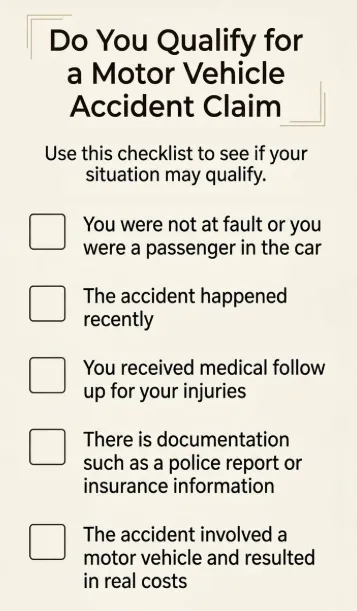
Do You Qualify for a Motor Vehicle Accident Claim
Use this checklist to see if your situation may qualify.
- You were not at fault or you were a passenger in the car
- The accident happened recently
- You received medical follow up for your injuries
- There is documentation such as a police report or insurance information
- The accident involved a motor vehicle and resulted in real costs
State rules matter but eligibility often depends more on timing injuries and documentation than location alone.
How Legal Claim Assistant Helps Motor Vehicle Accident Victims
Legal Claim Assistant can help victims understand whether their car accident may qualify for a claim.
The process starts with a free case review. This checks basic eligibility without pressure or promises. If the situation qualifies, Legal Claim Assistant helps match the victim with the right legal professional.
This approach saves time, reduces confusion, and helps injured people focus on recovery instead of navigating insurance company processes alone.
Frequently Asked Questions About Motor Vehicle Accident Claims
If you were hurt in a motor vehicle accident, it is normal to have questions about your rights, your next steps, and whether you may qualify for compensation. These answers are here to help you understand the basics and quickly see when it makes sense to explore a claim.
What should I do after a motor vehicle accident?
Your health comes first. Get medical help as soon as possible, even if your injuries do not seem serious at first. Some injuries take time to show symptoms. You should also report the accident, gather photos if you can, exchange insurance details, and keep records of your treatment, expenses, and missed work. If the crash was not your fault, these details can help support your claim.
How long do I have to file a claim?
The deadline to file a motor vehicle accident claim depends on the state where the accident happened. Every state has its own statute of limitations. If you wait too long, you can lose your right to seek compensation. That is why it is important to review your case as soon as possible after the accident.
Can I file a claim if I was a passenger?
Yes, in many cases you can. Passengers are often in a strong position to file a claim because they usually are not at fault for the accident. Depending on what happened, you may be able to seek compensation through the at fault driver’s insurance, another driver’s insurance, or other available coverage.
What if the other driver has no insurance?
You may still have options. In some cases, compensation may be available through uninsured motorist coverage or another policy that applies to the accident. Even when the other driver has no insurance, it does not always mean you are out of options. The key is to review the facts of the crash and the insurance coverage that may apply.
Can I still file a claim if I did not go to the hospital right away?
It depends on the facts of your case, but delays in treatment can make a claim harder. Insurance companies often argue that a delay means the injury was not serious or was caused by something else. That is why getting checked by a medical professional as soon as possible is important. The sooner your injuries are documented, the stronger your claim may be.
What compensation can I recover after a motor vehicle accident?
A claim may include compensation for medical bills, lost wages, pain and suffering, future treatment, and other accident related losses. The value of a claim depends on how serious the injuries are, how the accident affected your life, and how strong the evidence is. Every case is different, so the amount can vary a lot.
How do I know if I may qualify for a motor vehicle accident claim?
You may qualify if the accident was not your fault, you were injured, and you received medical care after the crash. Things like insurance details, medical records, photos, and a police report can also help support your case. A quick case review can help you understand whether you may have a valid claim.
You Deserve Justice. Let Us Help.
Speak with a trusted motor vehicle accident lawyer who will stand by your side, protect your rights, and fight for the compensation you deserve.
No win, no fee. Let experienced accident lawyers fight for the compensation you deserve.

Under 1 Minute

100% Free

Expert-Reviewed

Private & Secure
© 2025 Legal Claim Assistant. All Rights Reserved.
Terms of Service | Privacy Policy | Contact Us | Marketing Partners
Related Article
Should I Get a Lawyer After a Drunk Driving Accident?
When Does a Drunk Driving Accident Lawsuit Make Sense?
Share this article:


