


 Fact Checked By Our Attorneys
Motorcycle accident compensation claims can be complex, but you don’t have to navigate them alone. If you or a loved one has been injured in a motorcycle crash, now is the time to take action and pursue compensation with the help of an experienced personal injury lawyer. Don’t wait click the button below to get your free case review today and start your journey toward fair compensation and justice.
What is motorcycle accident compensation
Motorcycle accident compensation refers to the financial recovery you can receive when you have been hurt in a crash that was not your fault or for which you share limited liability. It covers tangible expenses like medical care and lost income, as well as less visible impacts such as emotional trauma and physical pain. These non-economic damages include intangible losses such as pain and suffering and emotional distress, which can be calculated using the multiplier method or the per diem method.
We have seen how riders and passengers who are unaware of their rights can miss out on the compensation they deserve. That is why it is so important to learn about the claims process, keep accurate records of your motorcycle accident injuries, and fully document the evidence of your crash. This documentation often involves photographs of the accident scene, including vehicle positions and road conditions, medical records documenting your injuries and treatment, and witness statements that provide critical support for your version of events. If you do not know where to begin, just remember that compensation is meant to make you “whole” again. It seeks to return you, as much as possible, to the position you were in before the accident.
How compensation is determined in a motorcycle accident
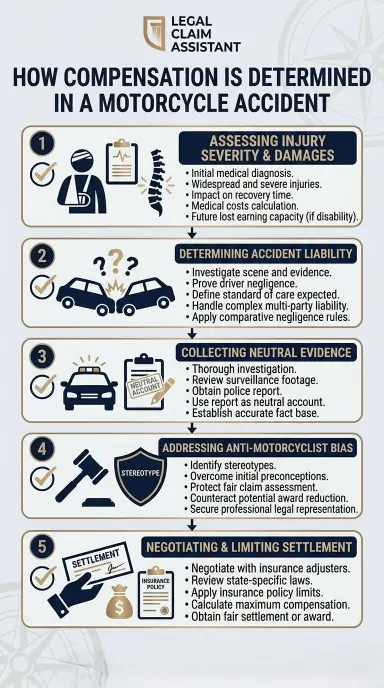
Several factors can influence how much you will be able to recover. First, the severity of your injuries is a huge point in establishing the scope of your losses. Widespread and severe injuries like spinal cord trauma or head trauma often bring longer recovery times, more intense medical care, and higher medical costs. Severity of injuries significantly affects compensation amounts, with catastrophic injuries leading to higher settlements. Future lost earning capacity is also a critical component of economic damages for victims with long-term disabilities.
Next, determining liability plays a central role. Motorcycle accidents often involve determining liability, which refers to who is legally responsible for the accident. Negligence is proven by showing that the other party failed to exercise ordinary diligence, which is the standard of care expected of a prudent person under similar circumstances. Establishing liability in motorcycle accidents can be complex, especially when multiple parties may share responsibility. In many states, including California, liability in motorcycle accidents can be shared among multiple parties, which is known as comparative negligence. The process to establish liability in a motorcycle crash involves a thorough investigation, which may include reviewing surveillance footage and police reports. A police report serves as a neutral account of the accident and is important for your claim.
It is important to note that motorcyclists face bias due to stereotypes and preconceptions, which can complicate their claims for compensation after an accident. This anti-motorcyclist bias can potentially reduce the award amounts, making legal representation crucial. Hiring a motorcycle accident attorney can significantly increase your chances of receiving fair compensation for your injuries and losses. An experienced motorcycle accident attorney understands the unique challenges faced by motorcyclists in legal claims and can help navigate the complexities of motorcycle accident claims, including establishing liability and negotiating settlements.
In addition, the maximum compensation is often limited by the at-fault driver’s insurance policy limits. Claim values are influenced by state-specific laws and minimum insurance requirements, which can affect the potential settlement amount.
Types of compensation available in motorcycle accident claims
Motorcycle accident claims often include several types of compensation, each intended to address a specific category of loss:
Medical expenses. These include immediate treatments such as ambulance services or surgery, as well as follow-up visits, therapy, and long-term rehabilitation. Immediate medical evaluation after an accident is critical, even for minor symptoms.
Lost wages. If you were forced to take unpaid time off or you lost your ability to work altogether, you might recover that lost income.
Property damage. This covers damage to your motorcycle and any attached gear, like saddlebags or modifications.
Pain and suffering. This accounts for the physical pain and the emotional trauma that arise from an accident.
Some riders or passengers also seek compensation for permanent injury or disability. Punitive damages may be awarded in cases of egregious behavior by the at-fault party. If you are preparing to file motorcycle accident claims, it is crucial to identify each category of loss that applies to your unique situation.
How much compensation for a motorcycle accident
Many people wonder about potential settlement numbers or how much compensation they could receive. There is no universal figure, but certain benchmarks can guide you. The more extensive the injuries and their impact on your life, the higher your motorcycle accident settlement is likely to be. For instance, someone whose medical bills and ongoing care total tens of thousands of dollars will generally recover a larger award than a person who only had minor scrapes.
If you are seeking general insights, you might find rough ranges by looking at data or reading about what is the average payout for a motorcycle accident. However, your own compensation depends on a unique blend of medical documentation, local legal precedents, and liability details. Remember that every case is different, and the best way to gauge potential recovery is by receiving a professional evaluation from an experienced motorcycle accident lawyer or personal injury lawyer.
How much compensation for motorcycle accident depends on injury severity and treatment
Because injuries vary from rider to rider, the level of compensation hinges on the seriousness of your medical needs. For example, fractured bones or road rash can cost a few thousand dollars to treat, while traumatic brain injury might require months of rehabilitation and specialized care. The more extensive your treatments, the bigger the claim.
Typical costs also include follow-up procedures, physical therapy, prescription medications, medical equipment, or in-home care support. When you negotiate or litigate, your legal team will usually gather every piece of medical evidence to show just how life-altering your riders injuries have been. If you have questions about the legal implications of a complex case, you could explore consulting a motorcycle accident lawyer. The attorney can help outline the expected ranges for your unique injuries and ensure you document each expense thoroughly.
How motorcycle accident compensation claims are processed
Motorcycle accident compensation often starts with filing a motorcycle accident claim or insurance claim. You submit documentation and evidence that highlights the costs of the accident, along with proof of who was at fault. Then the insurance adjusters representing either your insurer or the at-fault party’s insurer investigate the cause and extent of the loss.
The first formal step after a motorcycle accident is to file a police report and notify your insurance company. The insurance adjuster assigned to your case will review police reports, statements from all parties, and available evidence to determine who is at fault. The claims process involves identifying all parties involved and clearly establishing how the accident occurred to prove fault.
At this point, you may receive a quick settlement offer. Be cautious. Some preliminary offers may not account for the full scope of costs, especially future medical fees or intangible losses like non economic damages. If the insurance company’s offer is too low, you and your legal team might navigate negotiations or possibly a motorcycle accident lawsuit. Claiming compensation may involve additional legal measures, including hiring an attorney and potentially filing a lawsuit.
If negotiations are unsuccessful, the claim may lead to motorcycle accident litigation, where a court will determine how much you are owed. Throughout this legal process, thorough documentation and professional guidance play huge roles in reaching a fair settlement. Continuing to gather evidence, such as updated medical records and photographs of injuries, strengthens your case. Documenting your pain levels and mobility restrictions in a journal can provide personal insight into your suffering. Expert opinions, such as those from accident reconstruction specialists, can enhance the credibility of your evidence. Your attorney can help manage the evidence collection process, ensuring no critical details are overlooked.
Common mistakes that reduce motorcycle accident compensation
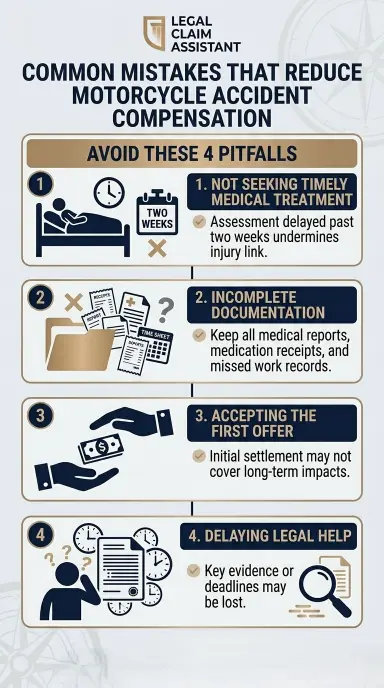
Small missteps early in your claim can lead to larger headaches later. We have noticed a few common pitfalls:
Not seeking timely medical treatment or doctor’s advice. Failing to get assessed within two weeks of your accident undermines the link between your injuries and the crash.
Incomplete documentation. Keep track of every relevant item, including receipts for medication, critical medical reports, or missed work records. Missing data makes it harder to show the real losses you experienced.
Accepting the first offer. When you jump on an initial settlement, you might miss out on the full and fair compensation you deserve, especially if that initial offer does not consider long-term impacts.
Delaying legal help. Some individuals try to handle the whole claim alone and lose valuable time or mar key details that an experienced motorcycle accident attorney or personal injury lawyer would have captured.
By streamlining how you handle deadlines and evidence, you set yourself up for stronger negotiations and better results.
How a motorcycle accident compensation lawyer can help maximize your claim
For many riders, deciding should i get a lawyer for motorcycle accident is not an easy choice. However, partnering with an attorney who focuses on motorcycle accident cases often yields notable benefits. First, they understand state and local statutes that affect liability, insurance coverage, insurance policy limits, and compensation caps. That alone can help shape the strategy for settlement or litigation.
Attorneys also know how to deal with insurance adjusters who might undervalue your injuries. They can push back against tactics designed to minimize settlement amounts. In addition, an attorney can coordinate the administrative side of the claim, such as following up on medical paperwork or verifying that crash-scene evidence is preserved. By shouldering those tasks, they help you focus on recovery.
Finally, working with a legal professional can be especially powerful if the accident caused life-altering injuries that require specialized documentation. For instance, if your case involves severe injuries, an experienced motorcycle accident lawyer can collect expert opinions from medical specialists and accident reconstruction specialists. All of this bolsters your claim and aims to maximize the financial outcome.
Many motorcycle accident attorneys work on a contingency fee basis, meaning you only pay if you win your case. Having a motorcycle accident attorney can alleviate the stress of dealing with legal proceedings while you focus on recovery. Attorneys can help you understand your rights and the legal process after a motorcycle accident, ensuring you are adequately represented.
Case studies showing successful compensation outcomes
Every case is different, but a few examples can illustrate how diverse these claims can be. One rider might have sustained a serious wrist fracture that resulted in three months off work and ongoing physical therapy. With help from a legal counselor, that rider gathered comprehensive medical records, wage statements, and witness statements from coworkers about missed opportunities. Ultimately, the settlement reimbursed the explicit medical bills plus lost earnings and an additional amount for pain and suffering.
Another scenario could involve a passenger who had no control over the accident. That individual might have been left with severe injury compared to others, but the at-fault driver tried to deny liability. However, with strong evidence from the police report, testimonies from other drivers, and a thorough medical record, the passenger won a significant motorcycle accident settlement. We have even seen instances where insurance companies originally downplayed the injuries, only to pay out more because the builder of the claim leveraged consistent, rigorous documentation.
These examples show the importance of having proper legal and medical support in place. Even when the path to fair compensation looks complicated, a well-structured claim with the right backing can prevail.
How insurance, liability, and documentation affect compensation amounts
Insurance policies often vary by state and can include specific clauses for uninsured or underinsured motorists. Who is responsible for your costs depends on the coverage at play and the degree of fault each party holds. If the at-fault driver has insufficient insurance, you may need to file a claim with your own policy under uninsured motorist insurance. This process is sometimes convoluted, but it is crucial to speak up if you believe your insurance coverage applies.
Liability rules also differ. Some areas use contributory negligence rules that can bar you from recovering anything if you share fault. Other locales use comparative negligence rules, which let you seek compensation minus your percentage of fault. As you move through the claim, keep records from each doctor’s visit, and file copies of any medical test results. If you wait too long to compile these, you might miss the statute of limitations to secure them easily. Having all documents on time is a sure way to strengthen your case.
How Legal Claim Assistant helps organize your claim and improve compensation
We designed Legal Claim Assistant to simplify an often-stressful situation. Our service aims to streamline the steps of reviewing eligibility, collecting the right documents, and connecting you with an ideal legal resource. To start, we help you gather essential records: accident scene photos, medical bills, police reports, and any insurance documents that might be relevant. This ensures you do not rely on memory alone when you file a claim.
Next, we guide you through completion of the initial paperwork. We know how quickly small omissions can delay or reduce your compensation. Once your claim is organized, we connect you with a trusted motorcycle accident law firm or attorney who has handled cases with similar facts. Everything we do is designed to support clarity and efficiency.
With the right guidance, you are better positioned to get the maximum compensation that reflects your real needs. Whether it is major surgery or an extended period of physical therapy, those costs deserve careful accounting. Our goal is to give you that chance to see the process through to a truly fair result. If you have questions about eligibility, next steps, or an attorney referral, consider reaching out to the Legal Claim Assistant platform to get your free consultation started. It is never too soon to take a step toward protecting your health, your finances, and your future.
You Deserve Justice. Let Us Help.
Speak with a trusted Motorcycle Accident lawyer who will stand by your side, protect your rights, and fight for the compensation you deserve.
No Win, No Fee. Let the Best Motorcycle Accident lawyers Fight for your Compensation!

Under 1 Minute

100% Free

Expert-Reviewed

Private & Secure
© 2025 Legal Claim Assistant. All Rights Reserved.
Terms of Service | Privacy Policy | Contact Us | Marketing Partners
Related Article

Should I Get a Lawyer After a Drunk Driving Accident?

When Does a Drunk Driving Accident Lawsuit Make Sense?
Share this article:


