Pedestrian Accidents at Intersections Who Is at Fault?
 Fact Checked By Our Attorneys
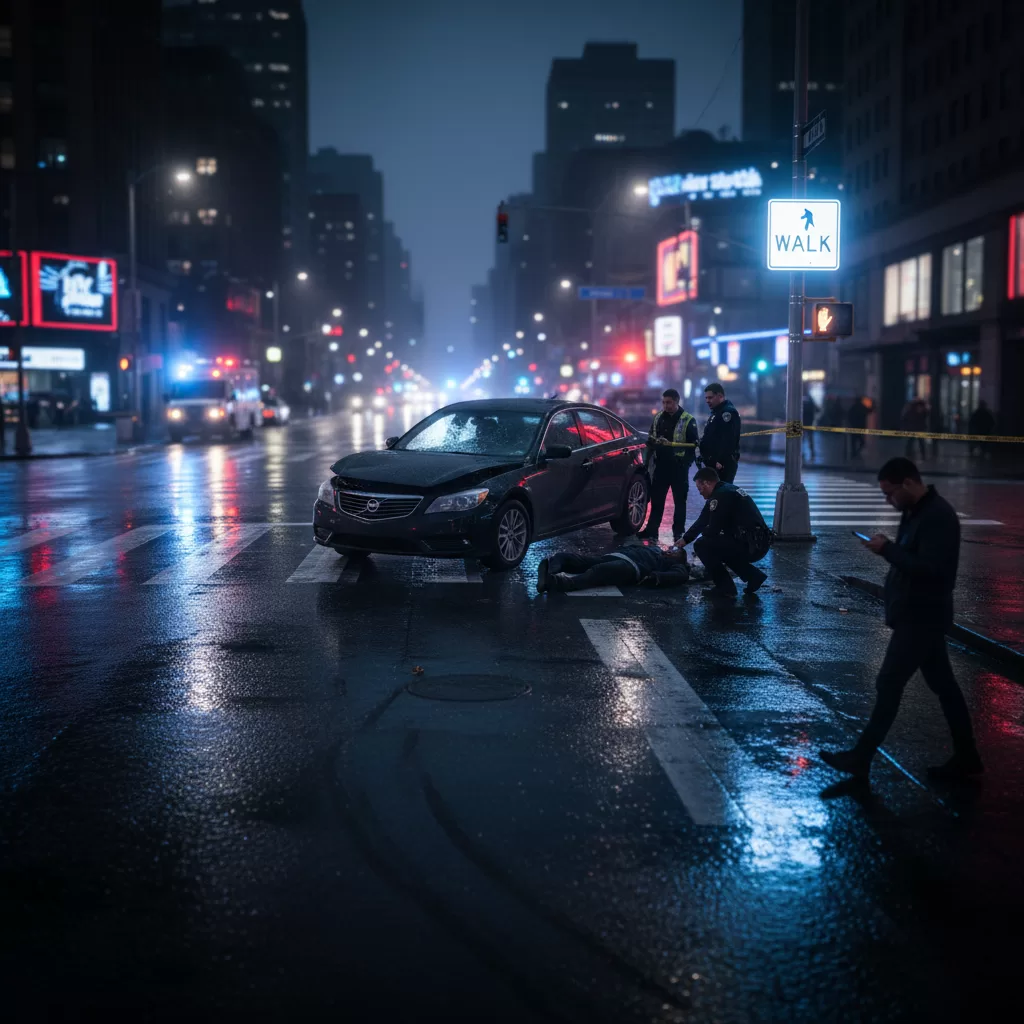
A pedestrian accident at an intersection can be complex, and understanding who is at fault is crucial to protect your rights and secure the compensation you deserve. If you or a loved one has been injured in a pedestrian accident at an intersection, don’t wait get a free case review today to see how we can help you pursue maximum compensation. Consulting an experienced pedestrian accident attorney can provide guidance specific to your situation and help ensure your claim is handled correctly.
Intersections are high-risk areas where vehicles, bicyclists, and pedestrians all converge, making it essential to have experienced legal support on your side. At Legal Claim Assistant, we specialize in navigating these challenging cases and fighting for your rights. Click the button now to start your free case review and take the first step toward justice and recovery.

No Win, No Fee. Let the Best Motor Vehicle Accident Attorneys Fight for your Compensation!
Table of Contents:

Understanding pedestrian accidents at intersections
Pedestrian crashes at intersections are more frequent than many people realize. The sheer volume of traffic and the presence of crosswalks and turning lanes create an environment where drivers and pedestrians might misinterpret each other’s actions. Even in broad daylight, a driver focused on making a right turn may fail to notice a pedestrian walking or people crossing the street. Turning vehicle accidents occur when cars making turns overlook pedestrians who are already in the roadway, and many left-turn pedestrian accidents happen when drivers are focused on watching for other vehicles and getting into their intended lane. Similarly, a pedestrian might assume that a traffic light grants safe passage without double-checking whether oncoming traffic and other vehicles have stopped.
Backup accidents happen when a car is backing out of a parking spot or driveway and fails to see a pedestrian walking behind it, and parking lot accidents frequently occur due to the constant movement of motor vehicles and limited visibility, creating a dangerous environment for pedestrians. Poor visibility in parking lots is a big risk for pedestrian accidents, especially since more than half of all pedestrian deaths happen on poorly lit roads. Upgrading to LED lighting that avoids pedestrian silhouettes can reduce injury crashes by up to 28%.
We often hear from victims who are surprised by how quickly an intersection collision occurs. From the injured person’s perspective, a crossing signal might indicate it is safe to cross safely, but an impatient or distracted driver could roll through the intersection. Distracted driving is a leading cause of pedestrian accidents, with drivers using smartphones failing to notice pedestrians in crosswalks. Crosswalk accidents can occur when drivers ignore traffic signals and fail to stop for pedestrians, leading to serious injuries or fatalities. Conversely, a pedestrian who crosses outside of a designated walkway, at unmarked crosswalks, or against a signal may place themselves in the path of oncoming traffic. Midblock crossings are common spots for pedestrian accidents when pedestrians cross streets outside of marked crosswalks. Jaywalking is a major cause of pedestrian injuries and deaths, often occurring when pedestrians cross the street without looking or are distracted. Understanding these overlapping elements is crucial for pinpointing why these traffic crashes happen and who should be held liable.
Intersection and intersection-related pedestrian fatalities contribute nearly one-fourth of all pedestrian fatalities in the US. In 2022, there were 12,036 traffic fatalities involving unsignalized intersections, highlighting the dangers of left-turn pedestrian accidents. Accidents at intersections and during left turns are among the most serious incidents for pedestrians. The turning motion and acceleration of vehicles during left turns create an impact that leads to serious injury for pedestrians. Drivers often overlook pedestrians who are already in the roadway when making left-hand or right-hand turns. Pedestrian accidents at intersections typically result from a combination of driver negligence, poor infrastructure, and environmental factors, with over 20% of all pedestrian fatalities occurring at these locations. Road users must be aware of multiple threats to safety in intersections, including vehicles approaching from the same direction, cross traffic, and pedestrians walking facing traffic.
Common types of intersection pedestrian accidents
Several factors can contribute to a pedestrian accident at an intersection. Although road conditions vary from one location to another, the underlying causes often share similar themes:
- Distracted driving\
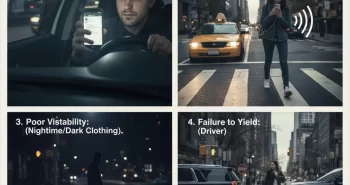
Drivers may be talking on a phone, checking directions, or responding to a text. At an intersection, even a few seconds of inattention can lead to a collision. Distracted drivers may not notice a pedestrian in the crosswalk, causing severe injuries. - Speeding and aggressive maneuvers\
When drivers exceed the speed limit or make abrupt lane changes, it reduces their reaction time and increases stopping distance. Higher vehicle speeds reduce a driver’s ability to react and stop in time, increasing the likelihood of fatality in pedestrian accidents. This heightened risk is amplified at signalized intersections and unsignalized intersections where pedestrians are more likely to appear. - Failure to yield\
We have observed many pedestrian accident cases where a vehicle driver ignores a yield sign or fails to respect a crosswalk. Failure to yield right of way is the most common factor in pedestrian accidents at intersections, especially when drivers are turning. This oversight can happen if the driver does not look both ways, merges too quickly from a driveway or side street, or races to catch a green light. Pedestrians must also remember that they are legally required to obey traffic signals to reduce risk. - Poor visibility and blind spots\
Intersections with inadequate street lighting, obstructed signs, or challenging weather conditions like bad weather leave both drivers and pedestrians struggling to see each other. Rain, snow, fog, or a dead bulb in a traffic signal can significantly worsen visibility, especially at night. A significant number of fatal pedestrian crashes occur at night due to poor visibility, especially when pedestrians wear dark clothing.
Responsible pedestrians also need to recognize how their own actions affect pedestrian safety. Individuals who cross mid-block, walk while distracted by mobile devices, or step into the roadway without checking traffic can inadvertently increase the risk of collision. In residential areas and urban areas, the lack of sidewalks or poor lighting can make these situations even more dangerous. Pedestrian accidents tend to happen most frequently in urban areas where vehicle traffic levels tend to be high. Most pedestrian injuries and deaths happen in cities due to heavy foot traffic and fast-moving motor vehicles on the nation’s roadways. Understanding these scenarios can guide you in identifying who may bear responsibility for your specific accident. If you would like to read more about the broader factors behind these incidents, our overview at what are the main causes of pedestrian accidents explains them in detail.
Determining fault in intersection pedestrian accidents
Determining fault often hinges on whether a driver or a pedestrian violated a traffic law or acted negligently. When an incident is reported to law enforcement, the responding officer typically documents the circumstances and decides whether one party broke any rules. For example, if the driver rolled through a stop sign, that evidence indicates potential wrongdoing on the driver’s part. However, if a pedestrian fails to walk facing traffic or ran across the street against a “Don’t Walk” signal or traffic signals change while they are still crossing, the responsibility may shift. Poorly timed signals can trap pedestrians, especially seniors or those with mobility issues, in intersections when lights change.
In complex cases, you may discover partial negligence on both sides. A driver could be speeding, and the pedestrian might also be partially to blame if they crossed improperly or failed to stay alert. While that might reduce the pedestrian’s claim, it does not necessarily eliminate it. The legal standards vary by jurisdiction. Pedestrians have legal rights to seek compensation even if they were partially at fault for the accident in some jurisdictions. If you believe you have a valid claim, or you have questions about pedestrian accident liability, a thorough investigation can help shed light on who should be held accountable. An experienced pedestrian accident attorney can guide the injured person through these complex scenarios to protect their rights.
The role of traffic signals and right-of-way rules
Most states require both drivers and pedestrians to follow traffic signals, signage, and right-of-way guidelines. In practical terms, that means when a traffic signal directs pedestrians to walk, drivers turning left or right generally need to yield. Many drivers fail to yield the right-of-way to pedestrians, particularly when making left turns at intersections. At the same time, pedestrians are obliged to stay within the crosswalk and obey signals themselves.
Even if the light is green for vehicles, drivers still have a responsibility to watch for pedestrians who are in or approaching the intersection. Right-of-way essentially designates who proceeds first and who must wait. When both sides are aware of these rules and respect them, the likelihood of a crash decreases. Unfortunately, many collisions stem from a driver or pedestrian who assumed incorrectly that the other party would stop. This is especially true in school zones or near a school bus where children may be crossing. Bus-related accidents often occur when pedestrians attempt to get on or off a stopped bus, especially if drivers fail to stop for school buses. If you have questions about local right-of-way laws, a legal consultation can clarify how they apply in your area.
Evidence to support your pedestrian accident claim
If you are pursuing a claim after an intersection collision, gathering proper evidence is critical. Photos and videos of the accident scene can reveal key details such as skid marks, signal locations, any obstructions, and the presence of backup cameras on vehicles. Eyewitness accounts, including statements from other pedestrians or nearby drivers, help reconstruct the event. Police reports generally include an officer’s observations, witness comments, and whether the officer decided to issue any citations.
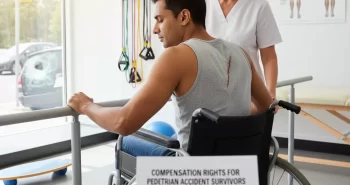
You should also preserve medical records related to your injuries. These might include hospital admission reports, bills for tests or surgery, and any follow-up treatments. Proof of ongoing physical therapy or counseling speaks to the severity of your case. This documentation is often used to quantify damages when filing or negotiating a pedestrian accident lawsuit. In a pedestrian accident lawsuit, special damages cover medical bills and lost income.
Shared fault and comparative negligence in intersection cases
Not all intersection accidents are black-and-white, and both the driver and the pedestrian may share some percentage of responsibility. Under comparative negligence laws, you can still recover compensation even if you are partly at fault, depending on the state’s rules. For instance, if you were 20 percent responsible for crossing at the wrong time, and the driver was 80 percent responsible for speeding through a red light, any final financial award might be reduced by your 20 percent share of the blame.
This shared-fault principle underscores the importance of precise accident reconstructions and careful documentation. Witness accounts and traffic footage might show that the driver had enough time to slow down or that the pedestrian actually started walking before the signal turned. Understanding your comparative negligence rules and working with an experienced pedestrian accident attorney can make the difference between a fair settlement and a denied claim. Pedestrian accident victims should seek help from a skilled accident attorney before speaking to insurance adjusters, ensuring that all road users’ actions are evaluated.
No Win, No Fee. Let the Best Motor Vehicle Accident Attorneys Fight for your Compensation!
Case studies: Successful intersection pedestrian accident claims
We have seen numerous success stories where injured pedestrians recovered damages because the evidence clearly demonstrated driver negligence. In one scenario, a driver attempted to beat a yellow light while turning left at an intersection, striking a pedestrian who was in the crosswalk. The pedestrian obtained surveillance footage from a nearby storefront, which confirmed the driver’s speed and disregard for the light. After negotiations, the insurance company agreed to a settlement that covered the victim’s medical bills, lost earnings, and pain and suffering. Consulting an experienced pedestrian accident attorney early ensured the injured person’s claim was fully documented.
In another situation, a pedestrian was partially at fault for stepping into the crosswalk just moments before the signal changed, yet the driver was texting at the time and had failed to slow down. Because of that, the jury ultimately placed most of the blame on the driver. These examples highlight how a thorough fact-finding process, including reviewing oncoming traffic patterns and unmarked crosswalks, combined with legal advocacy, can significantly improve a strong case.
Injuries commonly sustained in intersection pedestrian accidents
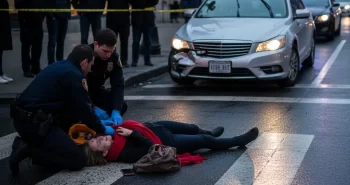
The force of a vehicle striking an unprotected individual can be severe. When these incidents unfold at intersections, the impacts can sometimes be even more violent, especially if a driver was accelerating to catch a green light. We frequently hear about broken bones, lacerations, or serious head trauma. Some pedestrians sustain spinal damage that leads to nerve deficits or partial paralysis, as we explore in pedestrian accident spinal injury. Fractures are also common, including the types we detail in pedestrian accident broken bones.
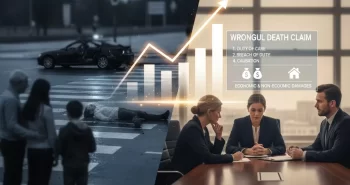
Other injuries that may result include traumatic brain injuries, deep bruising, and ligament tears. Emotional distress, such as anxiety or depression, can arise from the trauma of the crash and the long recovery ahead. If your accident involved a fatality, surviving loved ones might consider a pedestrian accident wrongful death claim. Intersection pedestrian accidents often result in severe injuries because pedestrians have no protection against the force of motor vehicles. The increasing prevalence of SUVs and trucks makes pedestrian accidents more severe, as the impact point is higher on the body. High-speed collisions are particularly dangerous for pedestrians, as the likelihood of severe injuries or fatalities increases with vehicle speed.
How insurance companies handle intersection pedestrian claims
When an insurance company evaluates a claim, their primary goal is to minimize the financial payout. They look for ways to argue that their insured was not primarily at fault or that the pedestrian’s actions contributed significantly to the crash. For instance, an insurer might use evidence that the pedestrian failed to walk facing traffic or crossed slightly before traffic signals changed to reduce or deny the claim. Alternatively, if the driver carried insufficient coverage or no coverage at all, you may need to file under your own uninsured motorist policy, as described in pedestrian accident uninsured driver.
We often encourage clients to avoid giving recorded statements or settling too quickly. Insurance adjusters may use friendly conversation to gather information that reduces claim value. A pedestrian accident law firm can represent your interests, negotiate on your behalf, and help you push back against lowball offers.
Legal options after a pedestrian accident at an intersection
You have several legal avenues to consider following an intersection collision. One choice is to file a personal injury claim or lawsuit against the at-fault driver’s insurance. This legal process involves gathering evidence, presenting it to the insurer, and negotiating a settlement. If no fair agreement can be reached, you may proceed to litigation in court.
Another potential route is to seek coverage through your own auto insurance policy, if it includes personal injury protection or uninsured/underinsured motorist coverage. Legal actions can also extend to municipal or state entities if a malfunctioning traffic signal or poorly designed intersection played a clear role in the incident. Ultimately, each collision has its own nuances, so speaking with us or acquiring pedestrian accident legal advice can clarify the path that best applies to you.
Steps to take immediately after an intersection accident
Prompt and thorough action can strengthen your position if you decide to pursue a pedestrian accident lawsuit. Below are a few immediate steps we recommend:
- Seek medical attention. Make sure you get evaluated, even if you initially feel unhurt. Some injuries develop symptoms over time.
- Document the scene. Take photos of the intersection, crosswalk lines, nearby traffic signs, and any visible injuries. Documenting the scene is crucial for the injured person and supports a strong claim.
- Gather information. Note the driver’s name, license number, insurance details, and license plate. Request contact information from witnesses as well.
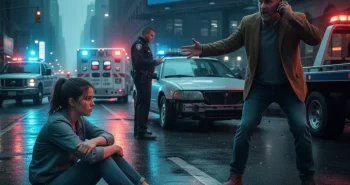
- Notify the authorities. Call the police so an official report can be made. This report often carries weight in insurance negotiations.
- Consider legal support. Speaking with a knowledgeable professional or a pedestrian accident lawyer can clarify next steps and protect your rights. They understand risks involving multiple threats and can advise on interactions with motor vehicles and other road users.
By following these initial measures, you are better positioned to protect yourself both medically and legally. If you need more specifics on what to do if you have been hit, check our guide on what to do if hit by a car as a pedestrian.
How our legal expertise can help you recover compensation
We understand the frustration and pain that follow a vehicle pedestrian accident. From hospital stays to mounting bills, you may feel overwhelmed by the long road to recovery. Our team at Legal Claim Assistant is committed to helping you cut through the red tape. By analyzing your case, we will determine whether you are entitled to pedestrian accident compensation and what the best strategy might be.
In many situations, seeking financial recovery involves more than simply filing a claim. We coordinate with accident reconstruction experts, gather medical records, and consult with specialists if your injuries are complex. We also negotiate zealously with insurance representatives who often attempt to undervalue claims. Our objective is to help you reclaim your health and financial stability by connecting you with the right legal professionals in your jurisdiction.
A collision at an intersection should not leave you feeling powerless. If you believe another party’s negligence caused your injuries, we encourage you to reach out. With the right evidence and advocacy, you could recover damages for medical bills, lost wages, pain and suffering, and more. We want you to know you are not alone in this fight. Contact us today for a free consultation and let us help you take the next step toward healing and fair compensation.
No Win, No Fee. Let the Best Motor Vehicle Accident Attorneys Fight for your Compensation!