


If you have been injured in a motor vehicle accident and want to ensure your claim is handled correctly, it’s crucial to understand motor vehicle accident ICD 10 codes. These standardized codes provide a clear and standardized description of the injuries sustained and the treatment provided, helping determine the full extent of your compensation. Don’t leave your recovery to chance focus on getting accurate documentation that supports your case. Click the button below now to get a free case review with experienced legal professionals who will help you navigate your claim and secure the compensation you deserve.
What Is the ICD 10 Code for Motor Vehicle Accident and How Doctors Use It
ICD 10 stands for the “International Classification of Diseases, 10th Revision,” a global standard endorsed by the World Health Organization for documenting patient diagnoses. When it comes to motor vehicle accident traffic incidents, there are specific codes that healthcare providers enter into your patient records to denote that your injuries resulted from a vehicle accident. These codes can include details about the type of vehicle involved, such as a pickup truck or car, whether you were the car driver injured or car passenger, and the general circumstances of the incident, including whether it was a traffic accident or a NOS road incident.
A full ICD-10-CM code can contain up to seven characters, including categories of injury or accident, injury type, and encounter stage. Characters 4-6 in the ICD-10 codes provide greater specificity, such as the person injured and whether it was a traffic or nontraffic event. The 7th character in ICD-10 codes signifies the stage of treatment, affecting insurance validation and reimbursement. For example, 7th Character Extensions indicate the encounter type: A for Initial Encounter, D for Subsequent Encounter, and S for Sequela.
V Codes (V00-V99) detail the external cause of the accident, identifying the type of transport accident and the role of the person involved. These V codes specifically refer to transport accidents, covering land, water, or air transport. For instance, V43.53XA identifies a car driver injured in a collision with a pickup truck on a public roadway, while V43.21S refers to a car occupant in a non-traffic collision. ICD-10 codes for MVAs are divided into diagnosis codes (S and T series) and external cause codes (V series). S codes are injuries to a single body region, while T codes refer to injuries to multiple or unspecified body regions. S Codes (S00-T88) describe the injury itself for specific body regions, while T Codes cover injuries to multiple or unspecified body parts.
Doctors use these standardized codes to record your medical care and share consistent information with insurers. Medical professionals use ICD-10 codes to document every injury a patient sustains during treatment. ICD-10 codes appear on the billing information sent to insurance companies and are essential for patient records, medical billing, and legal documentation of injuries from motor vehicle accidents. Accurate and detailed coding ensures that no aspect of an injury is overlooked during the claim process. Errors in ICD-10 codes can reshape the entire claim, affecting payment, treatment, or approval.
For example, S06.0X0A is used for a concussion without loss of consciousness, while S72.001A is specifically for a fracture of the neck of the femur. ICD-10 codes for motor vehicle accidents (MVAs) use specific alphanumeric codes from Chapter 19 and Chapter 20 to detail the injury type, affected body part, and accident circumstances. The ICD-10 code for motor vehicle accidents is categorized under the letter V, indicating the mode of transportation involved. Standardization of ICD-10 codes allows healthcare providers to share a clear ‘fingerprint’ of a patient’s medical history across institutions.
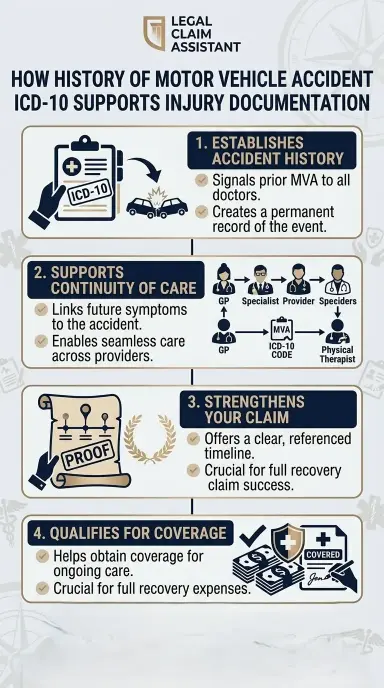
How History of Motor Vehicle Accident ICD 10 Supports Injury Documentation
If your medical records show a “history of motor vehicle accident” code, it indicates to any future doctor that you are a person injured in unspecified motor vehicle collision before. This matters because residual symptoms sometimes don’t show up until weeks or months later. By carrying that code forward, your providers can offer better continuity of care and link any new symptoms to the original accident if needed.
In addition, showing a history of a motor vehicle accident in your records can support your claim if you are still dealing with injuries or complications. It offers a clear timeline that can be referenced by specialists, physical therapists, and even your insurance company. Precise injury documentation often helps you qualify for coverage of ongoing treatments you need to fully recover.
Patients may need to look up ICD codes to ensure they’re accurate if their insurance company denied a claim. CMS provides access to several resources explaining ICD codes, including documents with commonly used codes.
What an Unspecified Motor Vehicle Accident ICD 10 Code Means for Your Claim
Occasionally, you might see an “unspecified motor vehicle accident ICD 10” code in your paperwork. This label indicates that your medical provider recorded a crash-related injury but the exact nature of the accident was not detailed. For example, they may have known you were in a collision but were missing facts about whether you were a car occupant, pedestrian, or driver. An unspecified car occupant injured code may appear if the exact role was unclear.
If your code remains unspecified, it might slow down your insurance process. Claims adjusters often require clarity on how the accident happened and who was at fault. If you notice an “unspecified” mention in your file, you can ask your healthcare provider to update or refine the note. When you and your provider work together to provide accurate information, it removes potential hurdles during the compensation process.
How Post Motor Vehicle Accident ICD 10 Codes Track Ongoing Treatment
When you have longstanding issues—like neck pain involving the cervical spine that flares up after the crash—doctors may use “post motor vehicle accident” ICD 10 codes to indicate ongoing treatment related to the incident. This distinction is important because it confirms that your current treatment is still tied to the original accident.
If your injuries require extensive rehabilitation, you could benefit from these follow-up codes, which often appear in subsequent encounter documentation. By linking your persistent pain or recurring complaints directly to the collision, these codes help justify uncovered therapies or specialized care through the insurance process. For example, if your chiropractor needs to confirm that your sessions are directly related to accident injuries, your post motor vehicle accident code provides backup.
When Driver Injured in Motor Vehicle Accident ICD 10 Codes Apply
“Driver injured in motor vehicle accident ICD 10” codes zero in on who was operating the car at the time of collision. This distinction can be vital for insurance coverage: if you were the car driver injured and another vehicle crashed into you, the at-fault driver’s insurance usually has a different process than if you were a passenger. The proper code ensures your medical records accurately reflect that you sustained injuries behind the wheel.
Even if you share partial fault, your health documentation still needs precision. Having the correct code makes sure that if you pursue compensation the claims process goes more smoothly. It also helps if your injury claim or legal case requires proof that you were driving and did not cause or share in causing the accident.
When Passenger in Motor Vehicle Accident ICD 10 Codes Are Used
Sometimes you were simply riding along, and the driver’s error or another vehicle’s negligence resulted in a crash. “Passenger in motor vehicle accident ICD 10” codes highlight that you suffered injuries without being in control of the vehicle. This can be particularly helpful in not-at-fault situations.
When you have a passenger-specific code, it clarifies your role and can strengthen a claim for compensation. Insurance companies often look at fault determinations to figure out how to pay out benefits. A passenger code shows you are less likely to bear responsibility for the incident and might simplify your path to reimbursement. If you are exploring a claim, you can learn more by checking resources such as passenger motor vehicle accident.
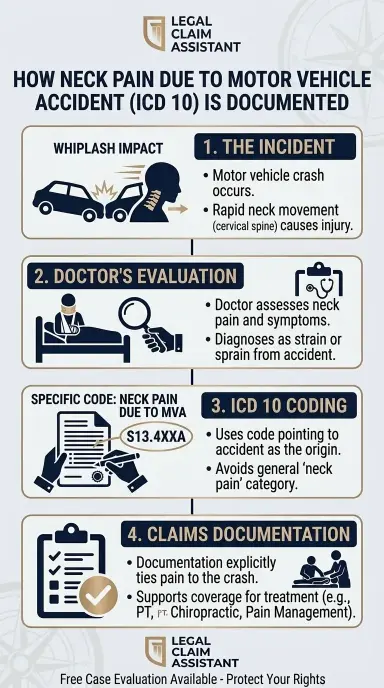
How Neck Pain Due to Motor Vehicle Accident ICD 10 Is Documented
Neck pain often referred to as whiplash is one of the most common symptoms after a crash. Whiplash injuries occur when your cervical spine rapidly moves forward and backward during impact. Doctors will use an ICD 10 code that points to the neck strain or sprain caused by a motor vehicle incident, often labeling it explicitly so insurers and physical therapists understand the origin.
Without this detail, your doctor might code your neck pain in a general category. That can lead to confusion for insurance adjusters or attorneys trying to tie your pain to the accident. By using a code that states “neck pain due to motor vehicle accident,” your documentation supports the cause and effect, ensuring you receive coverage for treatments like physical therapy, chiropractic care, or pain management.
How the ICD 10 Code for Motor Vehicle Accident Links Injuries to the Crash
When you look at your medical chart, you may see multiple ICD 10 codes. One could be for the specific injury (like a concussion or fracture), while another might denote that the cause was a motor vehicle collision. Combining both in your record is crucial: it links the event directly with your physical symptoms.
Think of it as an official chain of evidence. The code declaring an injury sets the stage for what you’re suffering from physically. The motor vehicle accident ICD 10 code steps in to show why you have that injury. This linkage can be essential when filing a motor vehicle accident injury claim and proves your injuries resulted from the crash, not from another cause.
Why Accurate Motor Vehicle Accident ICD 10 Coding Impacts Insurance Decisions
Insurance companies consider various factors before approving medical treatments or settlement amounts. One of the most critical elements is the official medical documentation. If your records do not clearly specify that your injuries stemmed from a crash, you could see delays or denials.
Insurance companies rely on ICD-10 codes to assess the nature and extent of injuries and process claims. Accurate motor vehicle accident ICD 10 coding prevents confusion about how a collision contributed to your condition. This matters whether you plan to file a motor vehicle accident lawsuit or simply want your bills paid. An accurate record also supports your credibility, showing consistency in your story and the facts of your case.
How ICD 10 Codes Help Confirm Treatment Timelines and Claim Eligibility
Almost every bodily injury after a car accident has its own possible timeline for healing. ICD 10 codes help illustrate the progression from the initial injury date or accident traffic initial encounter to any flare-ups or complications that arise later. This chronology supports your eligibility for compensation because it shows that you sought medical care within a reasonable window of the incident.
For example, if you visited the emergency room the day of the collision, then followed up with physical therapy a week later, your medical records with precise codes confirm the link to the crash. This consistent timeline helps insurance adjusters see cause, effect, and recovery path. If you suspect you might qualify for further compensation, you can explore motor vehicle accident compensation options to learn more.
The Role of ICD 10 Codes Alongside Police Reports and Insurance Records
Your police report and your insurance file both lay out important details about the collision. The ICD 10 codes in your medical records add a professional medical view of what happened to you physically. Together, all three documents create a full picture of the crash and its impact.
Police Report: Confirms when and where the crash took place and who may be at fault.
Insurance Records: Track coverage, policy information, and the claims process.
ICD 10 Codes: Connect your medical condition directly to the motor vehicle accident.
When these three are consistent and align in facts, they bolster your case significantly. If you find that something is out of order—maybe your codes are missing or the police report needs correction—it is worth making those adjustments early.
How Legal Teams Review Motor Vehicle Accident ICD 10 Codes to Protect Claims
Attorneys reviewing your case will pay close attention to your ICD 10 codes, looking for any mismatch between the medical narrative and the accident details. If your documentation does not reflect that your injuries are from the crash, your potential compensation could suffer. On the other hand, if your mentions of neck or back pain include the correct “motor vehicle accident” phrasing, it reinforces the validity of your claim.
Legal teams also know how to interpret the full extent and injury severity of your injuries based on ICD 10 codes. This information helps them decide what kind of settlement or trial strategy to pursue. If they see a strong correlation between the crash and any lasting disabilities, they can advocate more effectively on your behalf. If you are not sure whether it is worth pursuing legal action, exploring motor vehicle accident legal advice can help you decide your next steps.
Ultimately, proper ICD 10 coding acts as an ally for you, your medical providers, and any legal or insurance professionals working on your behalf. By linking your injuries clearly to the collision, verifying treatment timelines, and distinguishing whether you were a driver or passenger, these specialized codes secure your path toward fair coverage. And, most importantly, it can give you peace of mind knowing every piece of your recovery is accurately acknowledged.
You Deserve Justice. Let Us Help.
Speak with a trusted Motor Vehicle Accidents lawyer who will stand by your side, protect your rights, and fight for the compensation you deserve.
No Win, No Fee. Let the Best Traffic lawyers Fight for your Compensation!

Under 1 Minute

100% Free

Expert-Reviewed

Private & Secure
© 2025 Legal Claim Assistant. All Rights Reserved.
Terms of Service | Privacy Policy | Contact Us | Marketing Partners
Related Article

Should I Get a Lawyer After a Drunk Driving Accident?

When Does a Drunk Driving Accident Lawsuit Make Sense?
Share this article:


