What Is The Most Common Type Of Lift Truck Accident?
 Fact Checked By Our Attorneys
Lift truck accidents are evaluated legally based on the severity and impact of the incident rather than medical diagnosis details. Claims typically focus on whether the accident resulted in documented harm, loss of income, or long-term impairment that meets compensation thresholds. Injury descriptions are used only to establish damages within a legal claim, not for treatment guidance. These incidents are often classified among workplace accidents where safety standards and operational practices are closely reviewed.

No Win, No Fee. Let the Best Truck Accident Attorneys Fight for your Compensation!
Table of Contents:

Legal overview of lift truck accidents
Lift truck accidents commonly lead to legal claims when operator conduct, equipment condition, or workplace policies violate safety obligations. Investigations typically assess whether the employer, operator, or equipment manufacturer failed to meet required standards, creating grounds for a compensation claim. Understanding lift truck accidents often requires examining both operational practices and equipment conditions in detail.
Our experience shows that many incidents occur because of operator error, mechanical failures, or a mixture of both. Mechanical failures such as brake problems, steering malfunctions, or hydraulic leaks can quickly turn routine operations into dangerous situations. Operator errors like driving too fast, carrying loads that are too high or unstable, or improper maneuvering such as turning too sharply or at excessive speeds with an elevated load are significant contributors to forklift accidents. Another factor is how readily some companies rely on hurried or inadequate forklift operator training for new employees before assigning them to lift truck operation. Inadequate training and supervision of operators lead to lift truck accidents by causing poor judgment in load capacity and maneuvering. When loads are improperly stacked or operators are under pressure to meet deadlines, the risk of accidents multiplies. This creates scenarios where unsuspecting victims may suffer preventable forklift injuries, and forklift injuries tend to be more severe when heavy loads or moving equipment are involved.
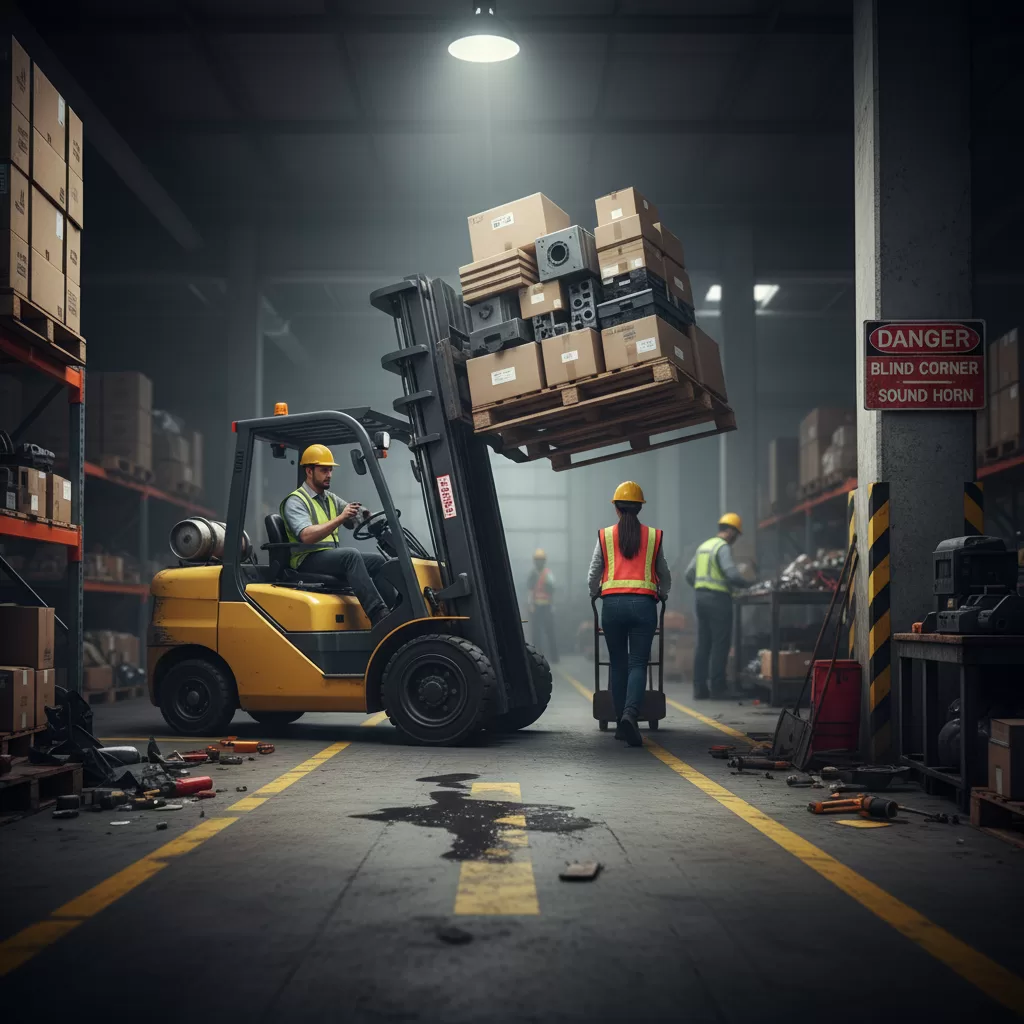
Operating on uneven surfaces, slopes, or surfaces with debris can lead to sudden weight shifts causing tip-overs. Uneven or slippery surfaces also contribute heavily to lift truck accidents. Overloading, unsecured, or poorly balanced loads significantly increase the risk, as the leading cause of forklift tip-overs is when the vehicle’s center of gravity shifts outside its stability triangle. Forklift tip-overs account for roughly 24-25% of all lift truck incidents and are responsible for approximately 42% of all forklift-related fatalities. Tip-overs are the most common and deadliest type of lift truck accident, accounting for nearly 70% of all forklift-related fatalities. Many of these events involve powered industrial trucks operating in busy warehouse environments.
Collisions involving forklifts can result in serious injuries and property damage. Pedestrian collisions occur when a forklift strikes or rolls over a person, often due to poor visibility, blind spots, or lack of signaling. Falls from forklifts can lead to severe injuries and typically occur when workers ride on forks or stand on the outside of machines. Crushed-by accidents happen when a person is trapped between a forklift and a fixed object, often resulting in severe injuries. Falling loads occur when a load tips, slides, or falls off the forks of a forklift, often due to improper loading or unsecured cargo. These types of truck lift accidents frequently occur in warehouses and distribution centers where heavy materials are moved throughout the day.
What is the most common type of lift truck accident
When we ask ourselves, “What is the most common type of lift truck accident?” the pattern that most safety experts identify is forklift rollovers or tipping accidents. Lift trucks have a high center of gravity, which makes them prone to tipping if loads are not balanced or if the lift truck operator turns too quickly on uneven or slippery surfaces. In addition, driving with elevated forks or making sudden stops can push the vehicle’s balance over the limit, causing it to flip onto its side.
Although not every forklift rollover accident results in severe harm, the vast majority involve some level of collision with the driver or bystanders. The immediate impact can cause crushing accidents, and individuals may be pinned under the machine. From our perspective, taking the time to provide comprehensive training programs for forklift operators and encouraging them to observe speed limits and use proper safety equipment such as seatbelts to prevent crushing injuries during a rollover are two straightforward steps that can help reduce the prevalence of these common forklift accidents.
Maintaining clear, well-lit aisles and designated pedestrian zones is vital in reducing accident risks. Employers should implement clear traffic patterns and ensure adequate lighting to reduce collision risks in workplaces. Employers must also ensure that all lift trucks are functioning at their maximum capacity and free of wear or damage. Daily inspections of the forklift and work area for hazards are crucial for preventing accidents.
Common liability causes in lift truck claims
Tip-overs typically receive the most attention from workplace safety authorities, leading most analysts to agree that these incidents rank high in both frequency and severity. However, pedestrian collisions and forklift pedestrian accidents are also regularly cited as the number one type of lift truck accident in certain industries. Small, crowded environments can exacerbate this problem, especially where visibility is poor or safety barriers are lacking.
We have found that the term “number one” can differ from one sector to another. Some forklift accident statistics highlight tip-overs as the top culprit, while others show collisions leading the pack. Regardless, tip-overs remain a significant contributor to disabling injuries and forklift related fatalities, making forklift operator training and hazard awareness essential ingredients for safer workspaces. Safety professionals often categorize these incidents among the most common lift truck accidents reported across industrial settings.
What is the number one cause of lift truck accidents
Speeding, distraction, and improper load handling are frequently cited as major causes in lift truck accidents, but the root cause is almost always related to inadequate forklift operator training. When drivers have a weak understanding of how the forklift behaves under load, they tend to misjudge stopping distances and cornering requirements. Stressful deadlines and fatigue further amplify these risks.
We emphasize proper training because a well-prepared lift truck operator is more likely to recognize red flags, such as uneven surfaces or an improperly balanced load. Additionally, well-structured refresher courses keep forklift safety top of mind for operators who might slip into bad habits over time. By ensuring that every operator is aware of the machine’s limitations and potential hazards, including emissions poisoning from excessive idling, we reduce the careless errors that lead to many serious forklift accidents.
Damages considered in lift truck claims
Lift truck accidents can cause a range of injuries, from relatively minor sprains to life-altering trauma. Common forklift injuries include fractures and broken bones often occurring when a worker is struck by a forklift or pinned between the machine and a wall. In tip-over accidents, crush injuries to the torso, arms, or legs are common, as the operator may be thrown out of the seat or trapped under the roll cage. Head injuries, including concussions or skull fractures, can happen if there is no overhead guard or if the guard proves ineffective in a severe collision.
In more serious incidents, internal organ damage may threaten a victim’s life and require immediate medical intervention. Beyond the physical harm, psychological trauma can impede recovery. We have seen many individuals struggle with anxiety around loud machinery and large vehicles after an accident. Seeking proper diagnosis and follow-up care, both physical and mental, is key to healing.
No Win, No Fee. Let the Best Truck Accident Attorneys Fight for your Compensation!
How liability is determined in lift truck accidents
Determining who is liable in a lift truck accident often involves scrutinizing workplace safety protocols, vehicle maintenance, and standard safety measures. Employers are responsible for providing a safe work environment, which includes proper training and maintenance of lift trucks. Failure to fulfill safety responsibilities can result in legal consequences such as fines, penalties, and lawsuits for employers. Conversely, if the operator blatantly ignored training or was under the influence of substances, liability may fall on that individual.
Occasionally, equipment manufacturers or forklift manufacturers can also be liable if the forklift or key components were defective. Product liability claims can be filed against forklift manufacturers if defective equipment contributed to an accident. We know that liability questions can become even more complex in scenarios involving multiple employers at the same worksite. Consulting with a legal team well versed in truck accident lawsuit procedures can be a decisive step in building a strong case and clarifying negligence.
Workers’ compensation typically provides primary benefits for injuries sustained in lift truck accidents at work, covering medical bills and partial lost wages. If a third party caused the accident, victims may file a lawsuit against them to seek compensation beyond workers’ compensation limits. Injured parties have a limited time to file a personal injury lawsuit after a lift truck accident, typically two years from the accident date in Nevada. Operators demonstrating negligence or disregard for safety protocols may face legal repercussions after a lift truck accident. Consulting with a personal injury lawyer can help victims of lift truck accidents understand their rights and pursue compensation. Legal action may be necessary if a fair insurance settlement is not reached after a lift truck accident.
Safety failures that create liability
Safety violations and failure to follow established operating procedures are often central to lift truck accident claims. When employers fail to enforce training standards, maintain equipment, or control hazardous work environments, liability may arise. These factors are reviewed to determine whether negligence contributed to the accident.
- Require comprehensive training programs and periodic refresher courses to keep forklift operators updated on safe handling methods.
- Enforce load capacity limits, ensuring operators never exceed the specified maximum weight when carrying loads.
- Maintain well-defined walkways for pedestrians and separate them from vehicle paths with safety barriers to reduce pedestrian collisions.
- Perform daily inspections on lift trucks, paying close attention to tire wear, steering functionality, and the integrity of hydraulic systems.
- Ensure operators always wear seatbelts to protect the operator’s compartment during tip-overs.
- Establish clear traffic patterns and ensure adequate lighting to reduce collision risks in workplaces.
- Train operators in proper load securing techniques to prevent falling loads during transport.
- Encourage operators to use proper mounting and dismounting procedures to prevent personnel falling accidents.
In our view, strict enforcement of these safety measures fosters a culture of caution and awareness. It also underscores to employees that occupational safety is not an afterthought but an essential priority day after day.
What damages can be recovered after a lift truck accident
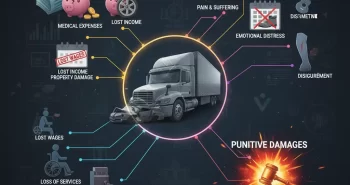
For injured victims, the aftermath of an accident can be overwhelming. Medical expenses, rehabilitation costs, and an extended loss of wages create a challenging financial picture. Depending on the specifics of each case, one may be able to recover various forms of compensation, often called “damages.” These can include immediate medical expenses such as ambulance rides, hospital stays, surgeries, and follow-up treatments. They can also extend to long-term rehabilitation costs, counseling fees for psychological impacts, and compensation for lost earning capacity if an injury prevents a return to the same line of work.
Damages can sometimes include pain and suffering, an amount intended to acknowledge how drastically the accident has changed a person’s life. In especially egregious cases involving willful misconduct by an employer or another party, punitive damages may be possible as well. We suggest working with an experienced truck accident law firm to evaluate all potential areas of compensation, as each claim’s value can vary greatly depending on the circumstances.
Real-life lift truck accident case studies
By looking at real-life scenarios, we can see how these accidents commonly occur. In one warehouse, a newly hired lift truck operator rushing to complete a tight shipment schedule misjudged a turn and caused the forklift to tip over. Fortunately, bystanders quickly removed the operator from under the cage, though he still sustained multiple fractures to his leg and pelvis. Investigations revealed the company had inadequately trained him, and the court found the employer liable for medical costs and lost wages.
In another case, an experienced driver collided with a parked pallet truck because of malfunctioning brakes. A coworker in the vehicle’s path suffered severe arm injuries. Further inspection uncovered a long history of skipped maintenance checks. This scenario ended in a settlement covering the coworker’s immediate treatment, lost income, and ongoing therapy costs. We see these examples as reminders that both forklift operator training and machinery maintenance must be a shared priority for workplaces.
How a lift truck accident lawyer can help
After an accident, many people do not realize how complicated the legal system can become when trying to secure a fair settlement. Negotiating with insurance providers, gathering evidence, and dealing with employer or manufacturer resistance can be daunting. An experienced lawyer, especially one with a background in truck accident litigation, can guide you through these steps. Their role includes building a compelling case by collecting witness statements, analyzing maintenance records, and consulting safety experts who can clarify whether negligence occurred.
We also know that legal professionals can evaluate settlement offers to ensure they truly reflect your losses and future needs. Rushing to accept an early, inadequate payout can leave you struggling with out-of-pocket medical expenses later. Retaining someone who has navigated truck accident claim disputes many times before provides the confidence that you have an advocate committed to protecting your rights. Ultimately, partnering with a truck accident lawyer dedicated to your well-being can help bring closure, financial relief, and peace of mind.
In summary, lift truck accidents are a serious concern whenever these vehicles operate near people or heavy loads. While forklift rollovers and collisions are common accidents, they do not have to be inevitable. Through proper forklift operator training, careful maintenance to maintain equipment, and following a strict culture of safety, we can reduce the incidence of these incidents. And for those who have already been harmed, legal recourse can help secure vital support on the road toward recovery. We hope this overview helps you better understand your options and take the next steps to safeguard your future.
No Win, No Fee. Let the Best Truck Accident Attorneys Fight for your Compensation!