Who Is Liable In A Truck Accident?
 Fact Checked By Our Attorneys

No Win, No Fee. Let the Best Truck Accident Attorneys Fight for your Compensation!
Table of Contents:

Who Is Liable in a Truck Accident
Liability refers to an individual’s or organization’s legal responsibility when a motor vehicle accident occurs. In the context of truck accidents, liability may not rest solely on the person behind the wheel. Our legal system recognizes that one or more parties can play a role in contributing to a collision, from corporate management making decisions that push drivers to meet unrealistic deadlines, to maintenance teams that fail to repair critical safety components or keep accurate vehicle maintenance records.
When we talk about “who is liable in a truck accident,” we typically consider a host of potentially liable parties. The simplest scenario is one in which the truck driver alone is at fault, perhaps by distracted driving or driver negligence. However, most truck accident cases do not happen in such a neat fashion. Commercial truck cases often involve corporate oversight, operational shortcomings such as negligent hiring practices, and manufacturing defects. Understanding the possible permutations of liability is the first step toward receiving appropriate compensation for your medical expenses, lost income, pain and suffering, and other damages.
Hiring a truck accident lawyer can help victims recover the most compensation with the least stress. Truck accident lawyers typically work on a contingency fee basis, meaning they only get paid if you win your case. An experienced truck accident lawyer can provide invaluable assistance with gathering evidence and building a case, as truck accident cases often involve multiple parties, making it essential to have knowledgeable legal representation. An attorney can also deal with the insurance companies representing the trucker and trucking company, which often have extensive legal teams.
How liability is evaluated in truck accident claims
Truck accidents differ from ordinary car accidents because they often involve multiple parties and the complex web of regulations and partnerships that govern the trucking industry. Federal agencies, such as the Federal Motor Carrier Safety Administration (FMCSA), set strict regulations on maximum driving hours, truck maintenance requirements, cargo securement, and truck weight limits. Trucking businesses must ensure their drivers comply with these safety regulations, or they risk severe penalties and potential legal exposure. FMCSA violations, such as hours-of-service violations, are significant in proving negligence.
Liability, in the legal sense, hinges on the concept of negligence. Negligence occurs if someone had a duty to act (or not act) in a certain way, failed in that duty, and caused harm as a result. To prove negligence, you need to establish that a defendant owed you a legal duty, failed to fulfill this duty, and that this breach caused you harm. When we investigate a truck accident, we often look for negligent behavior such as ignoring safety protocols, allowing improperly secured cargo or improperly loaded cargo, or allowing unqualified individuals to operate commercial vehicles. By gathering evidence from sources like driver logs, electronic logging devices (ELDs), the truck’s onboard electronic monitoring systems (black boxes), and vehicle maintenance records, we can piece together a clear narrative of how the accident happened and who contributed to it. An experienced attorney can issue preservation letters immediately after a crash, ensuring that none of this vital evidence is destroyed or altered.
Who Can Be Held Liable for Damages in a Truck Accident
Several entities can share liability for damages after a truck accident. Each party’s role and degree of fault vary from case to case. Although no two accidents are exactly alike, here are some of the common liable parties that might bear responsibility:
- Truck driver: Failing to follow traffic rules, distracted driving, driving under the influence, or not adhering to rest requirements. Truck drivers are responsible for obeying traffic laws and safe operation while adhering to federal regulations.
- Trucking company: Cutting corners on hiring or training procedures, negligent hiring practices, or setting poor scheduling practices that pressure drivers to rush, making the trucking company liable. The trucking company can be held liable for the negligent actions of its drivers under the doctrine of respondeat superior, which holds employers responsible for employees acting within the scope of their employment. Federal law mandates that interstate trucking companies carry significant liability coverage, often starting at $750,000.
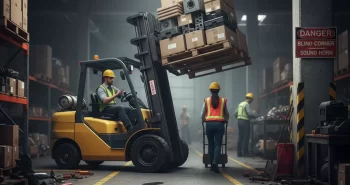
- Cargo loading company: Incorrectly loading or securing the truck’s cargo can cause loads to shift on the road and create control issues, making the truck unstable. Improperly loaded or unsecured cargo is a frequent cause of trucking accidents, and the cargo loading company may be held liable if their negligence is proven.
- Maintenance providers: Failing to inspect or fix mechanical problems that contribute to a collision due to poor truck maintenance. If a repair shop or mechanic performed faulty maintenance, they could be considered negligent.
- Truck manufacturer: Producing defective parts that lead to brake failures, tire blowouts, or steering malfunctions. If a truck accident is caused by a mechanical failure, the manufacturer of the truck or its parts may be held liable under product liability laws.
- Vehicle owner or leasing company: The truck owner or leasing company may be responsible for ensuring the vehicle is roadworthy and properly maintained.
- Government entities or contractors: Poorly maintained roads or dangerous designs can contribute to accidents, and government entities or contractors may share liability.
In some situations, a single act of negligence by one party is enough to spark a major crash. More often, though, these accidents involve cascading mistakes or oversights that add up and cause harm. Once liability is established for each potentially responsible party, injury victims can seek compensation for medical treatment, lost wages, rehabilitation costs, and more.
How Liability Is Determined in a Truck Accident
Determining liability is a methodical legal process that requires proper investigation, intangible legal knowledge, and detailed documentation of evidence. We start by examining police reports and eyewitness statements that describe the moments leading up to the collision. We also analyze data from the truck’s “black box,” if available, to see how fast the truck was going and whether the driver attempted to brake. A thorough review of driving logs, phone records, vehicle inspection reports, and corporate policies can reveal whether negligence stemming from the company or driver played a part. Regulatory penalties can arise from failing to comply with Department of Transportation compliance updates.
We often work together with accident reconstruction experts who use physics calculations and scene analysis to establish the chain of events. Their reconstruction can clarify whether the driver’s actions or a mechanical failure was the deciding factor. From there, liability might become more apparent, or multiple parties could be shown to share responsibility. The ultimate goal of this process is to ensure that damages are assigned fairly and accurately.
If a truck crash involves multiple vehicles, it could complicate determining liability in the accident, but the basic legal principles remain the same. Comparative negligence rules may apply in truck accident cases, meaning multiple parties can share liability based on their percentage of fault in the accident. Comparative negligence can split liability among multiple parties, including the victim.
Situations where the truck driver may be legally liable
The truck driver is typically the first person of interest when a crash happens. After all, drivers shoulder the responsibility to operate their vehicles safely, obey traffic laws, and follow the rules set by their employers. We see driver liability in clear-cut cases where someone was speeding, texting, or driving fatigued. A classic example is when a truck driver runs a red light and strikes a passenger vehicle, causing life-altering injuries or catastrophic injuries.
In other scenarios, driver liability is less obvious but still present. A collision might occur because the driver failed to check blind spots or neglected to signal while changing lanes. If the driver is an independent contractor and not a direct employee of the truck’s owner or a partnering business, liability may rest solely with the driver. In such a situation, filing a truck accident lawsuit becomes a direct claim against the driver’s insurance policy, though you might still be able to pursue other parties under certain circumstances.
No Win, No Fee. Let the Best Truck Accident Attorneys Fight for your Compensation!
When a trucking company may be held legally responsible
Trucking companies are responsible for the overall safety culture of their operations. If a company undertrains its drivers, sets unrealistic delivery deadlines, or fails to maintain vehicles properly, it can create hazardous conditions that lead to accidents. From our perspective at Legal Claim Assistant, many serious accidents stem from systemic issues at the corporate level rather than isolated driver mistakes.
For instance, if a trucking company forces drivers to exceed their federally mandated maximum hours or fails to conduct regular vehicle inspections, the trucking company is liable when accidents ensue. In practice, this means you could file a truck accident claim that names both the driver and the company as defendants. During legal proceedings, internal policies, safety records, and maintenance logs can shed light on whether the trucking company’s behavior directly contributed to the crash. The trucking company is responsible for engaging in proper hiring, training, and supervision.
Third party liability in truck accident claims
Collisions can also involve individuals or businesses that are not directly housed within the trucking company. Cargo loaders, for example, must ensure freight is properly balanced and secured. If heavy cargo shifts during transit and causes the truck to tip or lose control, liability could extend to the cargo loading company. Sometimes, the driver or trucking company may have little to do with cargo placement, especially if the truck was pre-loaded by a logistics partner.
Third parties can also be at fault when they fail to repair or inspect vehicles thoroughly. Independent maintenance workers, for example, might overlook a brake replacement or fail to spot a worn-out tire, inadvertently setting the stage for a future roadway incident. Identifying the root cause is key to establishing how these peripheral entities fit into the larger picture of liability.
Liability of Vehicle Owners and Manufacturers
Some truck accidents result from defective parts or subpar vehicle designs. Faulty brakes, hazardous steering components, or poorly designed tires can all cause a sudden inability to control the truck. When we identify that a specific part malfunctioned and led to the accident, the truck manufacturer or designer of that part might be deemed liable. In this scenario, product liability laws come into play, as these laws are intended to protect consumers from unsafe goods that land on the market.
Vehicle owners can also bear responsibility if they fail to make necessary repairs or skip recommended safety inspections. Owners who delay brake replacements or allow tires to remain dangerously worn could be deemed negligent. The key is to link that negligence or product defect to the actual cause of the crash. If, for instance, a critical brake failure occurs because the owner ignored multiple service warnings, then the driver’s immediate actions may be secondary to the problem that was years in the making.
Multiple Parties and Shared Liability
Most truck accidents involve multiple parties, making liability complex. Commercial truck accident cases often include layers of responsibility. For example, a trucking company that pushes drivers to meet unreasonable delivery windows could be partly at fault, while a drowsy driver who misses a stop sign could share liability. At the same time, if the truck’s tires had known defects, the manufacturer or a maintenance firm could hold partial responsibility as well.
In such a scenario, legal rules surrounding comparative or contributory negligence can come into focus. Under these rules, each party’s percentage of fault impacts how damages are awarded. Even the injured party can sometimes share a small portion of blame if their own driving decisions contributed to the collision. We often see that truck accident settlements reflect these nuanced determinations, ensuring that each responsible party pays a fair share.
Compensation available through truck accident claims
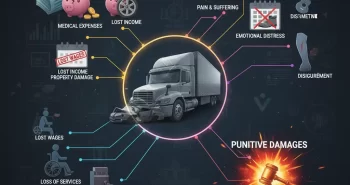
Claimants may seek compensation for documented losses and damages recognized under truck accident liability law. Compensation for truck accident victims can include punitive damages in cases of gross negligence. Surviving family members may receive compensation for funeral expenses, lost financial support, and emotional distress in wrongful death cases.
Personal injury protection (PIP) benefits cover medical expenses, some lost income, and replacement services, regardless of who caused the crash. However, PIP benefits will not compensate for damages such as pain and suffering. If auto insurance benefits do not cover the full extent of injuries after a truck accident, victims may file a liability insurance claim or personal injury lawsuit against liable parties.
The severity of injuries and the long-term impact on life will influence the amount of compensation recovered after a truck accident. In a truck accident lawsuit, victims can recover compensation for pain and suffering and other losses not covered by No-Fault insurance.
Victims should start on their truck accident insurance claims immediately to maximize their chances of recovery. The statute of limitations for filing a personal injury or wrongful death lawsuit after a truck accident is typically three years.
How Lawyers assess liability in truck accident claims
When multiple parties are involved, figuring out who is liable in a truck accident can feel overwhelming. An experienced truck accident attorney can sift through driving records, corporate documents, maintenance logs, and witness statements to map out the full picture of negligence. Working with a truck accident lawyer also gives you access to industry experts and investigative resources that might be difficult to obtain on your own.
Here are a few ways an experienced attorney may help:
- Collect evidence – Police reports, black box data, phone records, and witness statements are time-sensitive and critical in the legal process.
- Identify all liable parties – Experienced counsel will examine corporate structures, maintenance contracts, and insurance policies to include everyone who might share fault.
- Negotiate with insurance companies – Large trucking companies and their insurers have extensive legal teams. Your lawyer can negotiate on your behalf with a firm understanding of relevant laws.
- Represent you in court – If negotiations fail, your legal representation will be prepared to take your truck accident litigation to trial.
Many claimants want to know whether the circumstances of a truck accident qualify them to pursue compensation. A qualified personal injury attorney can examine your police report or insurance information and begin exploring your legal options right away. Whether it is proving that the trucking company neglected regular truck maintenance or showing that a cargo loader failed to properly secure freight, your lawyer will guide you through every stage of the claims process.
If you or a loved one has been involved in a truck accident,
consider reviewing your situation with a truck accident attorney to assess legal options with an experienced truck accident attorney to discuss your case and protect your rights.
No Win, No Fee. Let the Best Truck Accident Attorneys Fight for your Compensation!