Who Is Usually At Fault In A T Bone Car Accident?
 Fact Checked By Our Attorneys

A t bone car accident is one of the most dangerous side impact collisions you can suffer, often resulting in serious injuries like traumatic brain injuries and whiplash. If you’ve been injured in a t bone car accident, don’t wait get a free case review now to evaluate your rights and potential compensation. At Legal Claim Assistant, we connect injury victims with experienced attorneys ready to fight for the compensation you deserve. Click the button below to start your free, no-obligation case evaluation and take the first step toward protecting your future.

No Win, No Fee. Let the Best Motor Vehicle Accident Attorneys Fight for your Compensation!
Table of Contents:

What is a T bone car accident
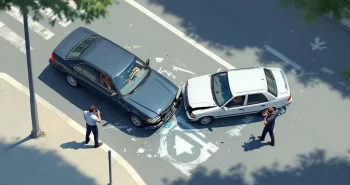
A t bone car accident involves a unique collision pattern where one vehicle’s front end collides with the side panel of another. Visually, these vehicles form a “T” shape upon impact. This type of accident often occurs at intersections, parking lot exits, or anywhere drivers attempt to cross or turn onto another roadway. T-bone accidents are among the most dangerous types of crashes on the road due to the limited protection offered by the sides of vehicles. The sides of a vehicle are generally thinner and offer less protection in a crash than the vehicle’s front or rear.
Modern car design uses a concept called ‘the crumple zone’ to absorb damage in a collision, primarily at the front and back of the vehicle. However, most cars have a critical design flaw where the sides absorb only 5% of the total incoming damage during a collision. Newer vehicles are improving their frames to resist more damage on the sides and adding side airbags to protect passengers. The force imparted in a collision is equal to mass times acceleration, which affects the severity of injuries in T-bone accidents.
T bone collisions are sometimes less obvious than a simple rear-end crash. The impact usually drives a car door or side panel inward, potentially hitting the driver or passengers. Occupants in the struck vehicle can experience a rapid jolt that puts the neck, shoulders, and head under severe strain, often leading to whiplash or more severe head and brain injuries. Meanwhile, the driver in the striking vehicle may suffer injuries if the front end crumples or the airbag deploys. Even injuries that are not immediately apparent can develop over hours or days, emphasizing the importance of seeking evaluation for internal injuries.
Although some t bone accidents happen at lower speeds, even a slow wreck can cause significant damage. If either driver fails to notice a stop sign, traffic signal, or tries to rush through an unsafe intersection, injuries to the neck, back, or head may be inevitable. By grasping the basic mechanics of how a t bone accident occurs, you can better prepare yourself to document the accident scene and talk with an insurance claims adjuster, personal injury lawyer, or car accident attorney about your injuries.
Common causes of T bone car accidents
Common triggers for a t bone collision revolve around driver error, misjudgment, or distraction. The following factors stand out as top culprits:
- Failing to yield: Drivers sometimes rush through a stop sign or fail to note a “yield” sign, putting them in the path of oncoming vehicles. Most T-bone accidents occur at intersections when one driver fails to follow right-of-way rules.
- Distracted driving: Checking a phone, adjusting music, or multitasking behind the wheel can cause drivers to miss critical signals or traffic patterns.
- Speeding and red-light running: Pushing through a light that has already turned red or depending on speed to “beat the yellow” can create the perfect setup for a side-impact collision.
- Impaired judgment: Drivers under the influence of alcohol or drugs risk slowed reaction times and poor decision-making at intersections.
Environmental conditions, such as bad weather or low visibility, can compound many of these issues. A driver might have every intention to stop on time but slides through an intersection on a wet or icy road. Still, in most scenarios, failing to follow basic traffic rules is the root cause. When a t bone car accident stems from these behaviors, proving fault often hinges on whether a driver ignored signs, violated traffic laws, or engaged in other negligent acts.
How serious can t bone car accident injuries be
The injuries that stem from a t bone collision can be life-altering. Injury victims frequently encounter a range of debilitating conditions, from soft-tissue trauma to permanent disabilities. Some of the most common examples include:
- Neck and shoulder injuries: The force of a side impact can jerk the body sideways, placing immense stress on muscles and ligaments, leading to whiplash.
- Head trauma: Drivers or passengers sometimes hit their head on the window, door panel, or steering wheel. A concussion or more severe head and brain injuries can follow. Head injuries, including traumatic brain injuries, are common in T-bone accidents when the head strikes the vehicle’s pillars or other vehicle occupants.
- Broken bones: Ribs, arms, legs, and pelvises are especially vulnerable since the collision often crushes the side of the vehicle inward.
- Spinal cord injuries: A jolt to the spine may lead to long-term mobility issues or even paralysis if the trauma is severe.
- Chest injuries: Seat belts can cause bruises or fractured bones in the chest during a T-bone accident.
- Abdominal injuries: Pressure from the lap belt can cause ruptured organs and internal injuries that may not be immediately apparent.
- Leg and knee injuries: The striking vehicle may cause the door to crumple, inflicting harm.
- Soft tissue injuries: Sprains and strains are common after T-bone accidents and can limit daily activities.
Survivors of T-bone accidents frequently experience psychological trauma, such as PTSD, anxiety, or depression. Approximately 22% of all passenger vehicle fatalities in the United States occur in T-bone accidents. T-bone accidents can result in a variety of injuries ranging from mild to severe. Some injuries from T-bone accidents may not show symptoms immediately, making medical evaluation essential after a crash.
Who is at fault in a car accident t bone
Determining who is at fault in a t bone car accident can be more complex than it first appears. Legally, fault hinges on negligence, or the failure to meet a basic standard of care. Sometimes, it is the at fault driver who ran a red light. Other times, a driver making a left turn across traffic fails to yield. In some situations, any number of parties may share fault in a T-bone accident under the principle of comparative fault, including the vehicle manufacturer if faulty components contributed to the crash. The vehicle manufacturer may share partial or full liability for your losses and injuries if faulty components contributed to the crash.
The driver who caused the accident has a legal obligation to remain at the scene, but that does not mean they will. Liability often depends on evidence such as traffic signals, eyewitness testimony, and accident reconstruction. Your car accident attorney or personal injury lawyer will prove liability by using evidence that shows the percentage of fault each party had in the crash.
Our approach is to determine liability by looking at how traffic signals were used, what witness statements indicate, and whether video footage of the intersection shows a specific violation. Even if the other driver insists they had the right of way, evidence from security cameras or nearby smartphones might tell another story.
Insurance companies also weigh fault heavily because it determines who pays and how much. If you are confident that the other driver neglected a traffic signal or was inattentive, gathering evidence is critical. This can involve photos of skid marks, statements from bystanders, and even an expert accident reconstructor. While each situation differs, your best chance of accurately assigning liability is to act quickly, document carefully, and consider seeking car accident legal advice right away.
Mistakes to avoid after a t bone car accident
When individuals experience a t bone collision, we often hear about oversights made in the chaotic aftermath. Minimizing mistakes can help preserve your health as well as your personal injury claim. Here are some pitfalls to watch out for:
- Admitting fault verbally at the scene. Emotional apologies or admissions can be twisted to imply you caused the wreck.
- Delaying or skipping medical care. It is essential to seek medical care immediately following a T-bone accident, even if no severe injuries are initially felt. Serious injuries can worsen if left untreated. Medical records also serve as evidence for your car accident compensation.
- Providing incomplete information to insurance. If you fail to mention certain symptoms or omit the name of a witness, you might harm your case.
Each of these missteps can diminish your legal standing. We recommend contacting a personal injury lawyer or seeking straightforward car accident legal advice if you suspect anyone might dispute your version of events. The intangible stress relief of knowing you have proper guidance often outweighs any initial hesitation about reaching out.
No Win, No Fee. Let the Best Motor Vehicle Accident Attorneys Fight for your Compensation!
Steps to take immediately after a t bone accident
When a t bone collision occurs, the accident scene can feel chaotic, but taking the right actions can stabilize the situation and protect your interests. Follow these recommendations:
- Ensure safety and protection. Check yourself and your vehicle occupants for injuries and call 911 to report the accident and generate an official police report. If possible, move your vehicle or alert others to prevent further crashes.
- Gather evidence. You should document as much as you can at the scene of a T-bone accident. Taking pictures, recording videos, and collecting statements from eyewitnesses can be helpful after a T-bone accident. Ask nearby witnesses for their contact details.
- Seek medical attention. Seeking immediate medical attention is crucial after a T-bone accident, even if injuries are not immediately apparent. Obtain a prompt evaluation, even if injuries appear mild. A thorough doctor’s report helps confirm the connection between the crash and your head and brain injuries or other internal injuries.
- Obtain an official record. A police report often contains key facts that clarify liability. Be sure to verify the officer’s contact information and your report number.
You should keep all documentation related to your expenses in a folder for easy access. Organized documentation becomes invaluable if the other vehicle’s insurance explores ways to minimize your compensation.
By following these practical steps, you reduce confusion, offer clear proof of what happened, and improve the likelihood of filing a strong personal injury claim. Also, do not forget to keep all related paperwork, such as hospital bills or prescriptions. Maintaining organized records of medical bills and correspondence with insurance companies is critical following a T-bone accident.
How medical documentation impacts your t bone car accident claim
Thorough medical documentation can make or break a t bone car accident claim. Injuries sometimes continue to develop weeks after the initial impact, and consistent visits to medical professionals help create a detailed timeline of your physical condition, including head and brain injuries and other internal injuries.
If an insurer challenges your injury claim, your medical records become the backbone of your argument. For instance, a detailed MRI reading or an x-ray report can highlight t bone accident injuries, while a physical therapy regimen shows the ongoing challenges you face in regaining mobility. Similarly, physician notes about pain or discomfort can validate claims of chronic or debilitating symptoms.
Beyond establishing proof of injuries, medical documentation can also affect the amount of compensation you ultimately receive. By outlining every diagnosis, procedure, or therapy session, you show the insurer that your medical costs are not arbitrary. When it is time to negotiate a settlement, having robust records often leads to a more favorable result and strengthens your personal injury claim.
Maximizing your compensation after a t bone car accident
Securing a fair settlement after a side-impact collision may require patience and strategy. Each claim is unique, but the following tactics often lead to a stronger outcome:
- Document every expense. Keep track of ambulance bills, hospital stays, therapy fees, prescription costs, medical bills, and anything else related to the accident.
- Prove lost wages. If you miss work or lose potential earnings, gather pay stubs and employer notes to show the effect on your finances.
- Be mindful of insurance adjusters. Even during friendly conversations, an adjuster may look for statements that minimize your injuries. Stay concise and factual.
- Meet legal deadlines. There are strict timelines for filing claims and lawsuits after injuries are sustained in a Florida traffic crash. Failing to meet deadlines for filing personal injury claims can jeopardize your case. If you have to manage multiple tasks, consider consulting a car accident law firm.
- Communicate with a car accident attorney or personal injury lawyer. These professionals help guide your repair process, evaluate the accident scene, and advise on how head and brain injuries, t bone accident injuries, and other severe injuries should be documented for your claim.
Maintaining a personal journal of any physical discomfort, anxiety, or disruptions to daily life can also reinforce your legal argument that the collision caused lasting harm. By combining these efforts, you can present a comprehensive picture of your financial and personal losses, setting the stage for a more substantial car accident compensation award or settlement.
How our t bone car accident lawyer can help
Navigating insurance claims, gathering evidence, and negotiating settlements can become a full-time job. That is where a specialized t bone car accident lawyer steps in. Legal Claim Assistant connects you with professionals who understand how to piece together collision details, calculate damages, and advocate on your behalf.
An experienced lawyer investigates the accident scene, consults with accident reconstruction experts if necessary, and ensures every relevant piece of evidence is preserved. Their aim is to explain complex legal rules in plain language while helping you decide how to pursue your claim—whether through a negotiated settlement or litigation. They can also advise if a rental car is needed during the repair process while your vehicle is being repaired.
Our role is to streamline your path, giving you the freedom to focus on healing. If you are weighing whether to hire a lawyer, remember that many law firms offer free consultations. That conversation alone can clarify your next steps. In complex side-impact crashes, your decision to bring in a car accident attorney often means the difference between accepting a low offer and securing the protection and support you need for a thorough recovery.
By understanding fault, documenting injuries, avoiding common mistakes, and seeking qualified legal help, you can take significant steps toward fair compensation. A t bone car accident does not have to disrupt your life indefinitely. With a clear plan and the right resources, you can address your medical concerns, protect your financial interests, and move forward with greater peace of mind.
No Win, No Fee. Let the Best Motor Vehicle Accident Attorneys Fight for your Compensation!