


Being involved in a t bone motor vehicle accident can be overwhelming and confusing, but getting a free case review from an experienced car accident lawyer can help you take control of your situation. Sometimes called a side-impact collision or broadside accident, this type of crash often happens in intersections and can lead to severe injuries and significant vehicle damage. Don’t wait click the button below now to get your free consultation and find out how you can seek compensation for your injuries and losses.
What Is a T-Bone Motor Vehicle Accident
A T-bone motor vehicle accident is a collision where the front of one vehicle strikes the side of another at roughly a right angle, creating a “T” shape. This sudden impact can cause significant damage to both vehicles involved, especially for those in the vehicle’s side that has been struck. Unlike rear-end collisions, where barriers like trunk space and back seats may absorb some of the force, T-bone accidents often hit close to passengers. As a result, serious injuries such as traumatic brain injuries, broken bones, or even fatalities may occur.
You will typically see T-bone crashes happening at intersections, where one driver fails to obey traffic laws, such as ignoring traffic signals or failing to stop at a stop sign. If the striking driver is speeding or runs a red or green light, the potential for devastating harm is much higher. In many cases, the battered driver has little time to react or maneuver away from oncoming traffic or the other vehicle. If you find yourself in this situation, you may be left with a damaged vehicle, costly medical bills, and a sense of confusion about who pays and what your rights are.
People involved in side-impact collisions often wonder where to start. One option is talking with a professional to help you understand your legal standpoint. If you or a loved one was injured in a motor vehicle accident, you may benefit from evaluating your situation with a car accident lawyer or personal injury lawyer who focuses on motor vehicle accidents.
How T-Bone Accidents Occur
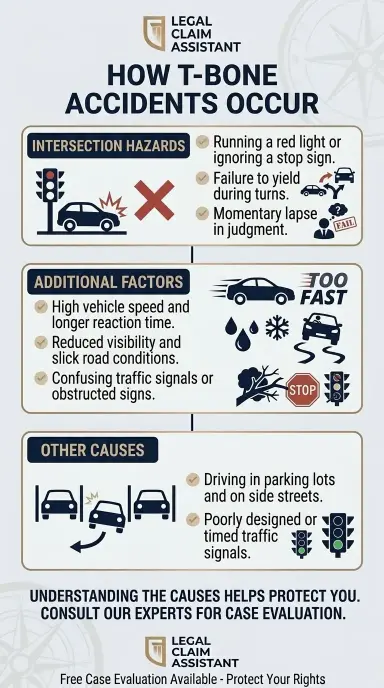
T-bone collisions occur most often at busy intersections where drivers must pay close attention to traffic lights, traffic signals, signs, and the actions of other motorists. When one driver proceeds forward and another tries to turn or cross the intersection, a side impact accident becomes much more likely. For example, a driver who runs a red light or ignores a stop sign and strikes your car as you legally enter the intersection can cause a powerful impact on your side doors. Even a momentary lapse in judgment or failure to obey traffic rules is all it takes for a T-bone collision to happen.
These broadside collisions can also occur in parking lots or on side streets, especially when visibility is poor. Another factor is speeding: a vehicle traveling too fast has less time to react, which significantly increases the force of a T-bone car accident. Even someone driving at moderate speed can cause serious harm if they do not stop in time.
Weather conditions, such as rain or snow, can make roads slippery, reducing tire traction and lengthening stopping distances. If one or both drivers lose control, their vehicles may collide in a T-formation. Meanwhile, poorly timed traffic signals or obstructed traffic signs can confuse drivers. In such cases, you might feel uncertain about whether to proceed or yield, and that confusion can lead to a side impact accident.
Common Causes of T-Bone Accidents
T-bone accidents rarely occur without a trigger. The following factors often play a role:
Driver fails to yield: Drivers who ignore a “yield” sign, run a red light, or fail to look both ways may cause a side-impact collision.
Distracted driving: Texting, eating, or adjusting GPS can cause a driver to miss a crucial change in traffic signals or skip checking for oncoming traffic.
Impaired driving: Substance use slows reaction time, making it harder to react to traffic signals and crossing vehicles.
Speeding: Accelerating through a light or trying to outrun a yellow signal can lead to a mid-intersection collision with a legally proceeding vehicle.
Poor weather or visibility: Rain, snow, or fog can hide important markers on the road or make it harder to brake in time.
Even if you feel confident in your driving abilities, you cannot control another driver’s decisions. That is why T-bone collisions occur so suddenly. If you were struck by a negligent driver, you may want to consider filing motor vehicle accident claims to seek financial compensation that addresses property damage and medical costs.
Determining Who Is at Fault in a T-Bone Accident
Establishing fault in a T-bone motor vehicle accident can be complex. The driver who appears at first glance to be responsible might argue they had the right of way or that there were extenuating circumstances. In side-impact collisions, both parties may claim the other is at fault. Insurance companies and your car accident attorney will typically investigate all available evidence, including police reports, witness statements, traffic cameras, and photos of the accident scene.
For instance, if a driver runs through a red light and strikes your vehicle in the middle of your lawful turn, they bear significant responsibility. In other situations, you may have entered an intersection on a yellow or green light when you should have stopped, complicating the blame. Fault can also be shared in some jurisdictions. If a court or insurer decides each driver contributed to the crash, compensation may be split accordingly.
Additionally, the local traffic laws and any unique conditions at the time of the collision can impact fault. The key is gathering as much other evidence as possible right away. By contacting law enforcement immediately and ensuring you collect contact information from witnesses, you help preserve the evidence you may need for determining liability. You might also want to request a motor vehicle accident report, which often provides valuable details for insurance and legal processes.
Parties Potentially Liable in a T-Bone Accident
In many T-bone accident cases, another driver ends up primarily responsible. However, there are instances where additional parties can face liability, depending on how and why the collision occurred. Potentially liable parties include:
The at-fault driver: A motorist who breaks traffic laws, drives distracted, or fails to yield can be directly responsible for damages.
Vehicle manufacturer: If a vehicle defect, such as faulty brakes, leads to the inability to stop, the carmaker might share legal responsibility.
Employer of the at-fault driver: When a driver is on the job during the collision, their employer might bear some liability.
Government agencies: Poorly maintained roads, missing signage, or malfunctioning traffic signals can sometimes result in government entities becoming partially accountable.
Identifying every potentially liable party can strengthen your claim if you were the injury victim. You may be eligible to recover financial compensation from multiple sources, which can help cover medical expenses and other financial losses. This broader approach is important if you are facing debilitating injuries and need the maximum coverage available. A thorough investigation usually begins with you, eyewitnesses, and the police who responded to the accident scene. If you have questions about your legal rights, you could look for motor vehicle accident legal advice to clarify your options.
Typical Injuries From T-Bone Motor Vehicle Accidents
A t bone motor vehicle accident can result in a wide range of injuries because the door or side panel provides minimal protection compared to the front or rear of a car. Common injuries include broken ribs, pelvic fractures, head trauma, traumatic brain injuries, and back or neck strains. Whiplash is also frequent, especially if the impact jostles your head and neck sideways.
In severe cases, passengers on the side of the impact may be pinned in the vehicle, causing crush injuries that are life-threatening. Even if you feel “okay” after a strong jolt, it is wise to seek medical attention promptly. Some injuries, like concussions or internal bleeding, might not show immediate symptoms. Seeking care early can help detect hidden issues and provide documentation if you want to file a claim.
Serious injuries often mean you will have medical bills, potential rehab costs, and lost income if you are unable to work. If your injuries impact your everyday life, you might be eligible for motor vehicle accident compensation to ease the financial burden. A doctor’s advice, hospital records, and consistent follow-up care can all add weight to your case.
How a T-Bone Accident Lawyer Can Help
A T-bone accident lawyer specializes in advocating for injury victims of side-impact crashes, handling everything from gathering evidence to negotiations with insurers. When you are trying to recover physically and emotionally from the crash, tackling legal intricacies on your own can be overwhelming. Although you are not required to have an attorney, having a car accident attorney or legal team by your side may protect you from settling for less than what you truly deserve.
Your lawyer can help piece together the collision’s sequence of events by reviewing police reports, video footage, and witness statements. If there is a dispute over fault, an experienced attorney can use your state’s traffic laws to build a strong argument. They can also access accident reconstruction specialists or medical experts to strengthen your claim.
Additionally, a lawyer negotiates firmly with insurance companies, which often offer low settlements to injured people who are not familiar with the claims process. If negotiations fail, your attorney can guide you toward filing a motor vehicle accident lawsuit. This next step shows the insurance company you are serious about seeking fair compensation. Throughout the process, you can focus on healing while your legal counsel focuses on maximizing the outcome of your case.
Compensation Available After a T-Bone Accident
If you become the victim of a T-bone collision, the compensation you might receive usually depends on the extent of your injuries and other losses. Damages commonly include coverage for medical bills, rehabilitation services, and lost wages if you needed time off work. More severe or long-lasting injuries can lead to higher settlement amounts because of ongoing healthcare costs. Non-economic damages may also be awarded for pain, suffering, and the emotional toll the accident placed on you.
In cases where the at-fault driver’s behavior was extremely reckless or involved driving under the influence, you could potentially recover punitive damages. Punitive damages aim to punish and deter future wrongdoing rather than compensate you for specific loss. However, not all states award them, and you typically need to prove gross negligence or willful misconduct.
If you prefer a clearer idea of potential compensation, you could check a motor vehicle accident compensation calculator to get an initial overview. Remember that no two collisions are exactly alike, and your unique circumstances affect the final amount. The more evidence you present to show fault and demonstrate your financial, physical, and emotional losses, the more likely you are to secure a settlement or court award that covers your needs.
Steps to Take Immediately After a T-Bone Accident
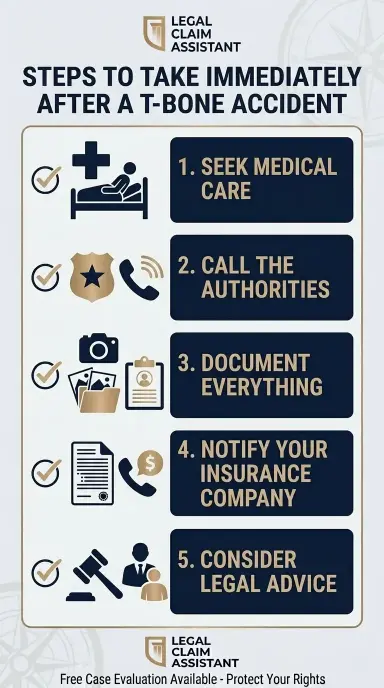
What you do right after a T-bone motor vehicle accident can drastically influence the outcome of your claim. It is natural to feel shaken, but staying calm and organized will help protect both your health and any future case. Consider the following steps:
Seek medical care: Even if you believe your injuries are minor, get checked out by a healthcare professional. This ensures you treat hidden injuries and have documentation.
Call the authorities: A police report can be a vital piece of evidence later. Make sure to exchange contact and insurance information with the other driver.
Document everything: Take photos of the accident scene, your vehicle, and any injuries. If possible, collect names and numbers of witnesses.
Notify your insurance company: Promptly report the crash to start the claims process. Stick to the facts, and avoid speculation about fault.
Consider legal advice: If you are unsure about your next step, you might look into what to do after a motor vehicle accident or consult a law firm or personal injury lawyer to ensure you do not forfeit any rights.
Remember to maintain all medical records, bills, and any communication from insurance adjusters. The more organized you are, the fewer hurdles you will face when trying to prove your case or negotiate with insurance companies.
How Evidence Supports Your T-Bone Accident Claim
Evidence is essential for showing that the other driver or another party bears responsibility for your injuries and financial losses. Solid documentation can make all the difference, especially if the at-fault driver denies liability or the insurance carrier tries to minimize your claim. Photographs of the accident scene can illustrate how the two vehicles collided and highlight important details, such as skid marks or the position of traffic signals. Witness accounts can strengthen your argument by confirming that the other driver ignored a red light or was speeding.
Your medical records and doctor’s evaluations help connect your injuries directly to the T-bone motor vehicle accident. This link is vital for obtaining fair financial recovery. The earlier you collect documentation, the more reliable it tends to be. Over time, memories fade, and witnesses become harder to locate. You can also preserve text messages or any digital correspondence showing the other party admitted fault. If you are uncertain how best to gather or present evidence, you could consult an attorney or explore motor vehicle accident evidence resources for guidance.
Overall, a well-documented claim provides clarity about what happened, who is accountable, and how much compensation you should receive. If you take time to build a strong foundation of evidence, you stand a far better chance of resolving your claim favorably, whether through settlement or courtroom proceedings. This approach frees you up to concentrate on healing and moving forward after a difficult, unexpected event.
You Deserve Justice. Let Us Help.
Speak with a trusted Motor Vehicle Accidents lawyer who will stand by your side, protect your rights, and fight for the compensation you deserve.
No Win, No Fee. Let the Best Traffic lawyers Fight for your Compensation!

Under 1 Minute

100% Free

Expert-Reviewed

Private & Secure
© 2025 Legal Claim Assistant. All Rights Reserved.
Terms of Service | Privacy Policy | Contact Us | Marketing Partners
Related Article
Should I Get a Lawyer After a Drunk Driving Accident?
When Does a Drunk Driving Accident Lawsuit Make Sense?
Share this article:


