How Do You File A Truck Accident Claim?
 Fact Checked By Our Attorneys
How to file a truck accident claim involves identifying potentially liable parties, preserving evidence, and documenting legally recoverable damages. This page outlines how the claim process works, what records are commonly used to support compensation, and when a truck accident lawsuit may be appropriate. If you’ve been in a truck accident, get a free case review from experienced attorneys who can guide your claim and help you recover maximum compensation.
Understanding how truck accident claims work can help injured victims prepare for the legal and financial steps that follow a serious collision.

No Win, No Fee. Let the Best Truck Accident Attorneys Fight for your Compensation!
Table of Contents:

How to file a truck accident claim
Filing a truck accident claim involves much more than just filling out forms. Truck accident claims are often complicated due to multiple insurance companies, federal trucking laws, and large corporate defendants. We have seen many truck accident victims jump straight to paperwork, only to discover that they neglected crucial evidence or key details. To get started, gather basic facts such as the location of the accident scene, names and contact details of all parties involved, and information on vehicle damage. You will also want to document all financial losses and property damage related to the accident to build your claim.
Many truck accident cases involve significant property damage and serious injuries that require careful documentation from the very beginning.
Once you have assembled essential details, the next step is to notify both your own insurance company and, when appropriate, the at-fault party’s insurer. You should notify your own insurance company as soon as possible after the accident. You may file a first-party claim with your own insurance or a third-party claim with the at-fault party’s insurance. Be prepared to present supporting evidence of your losses. While you can begin this insurance claim process on your own, we have found that consulting with a skilled truck accident attorney or an experienced truck accident attorney can help streamline the claim from the beginning. A legal professional ensures that each form is completed accurately and that no detail slips through the cracks.
If the insurance company denies responsibility or delays your claim, having detailed documentation can become especially important for protecting your rights.
Understanding the truck accident claim process
The truck accident claim process typically includes a few phases. First, there is a thorough investigation where critical evidence is collected, including black box data and witness statements, and the roles of liable parties are established. Black box data from the truck can provide critical information about the vehicle’s speed and driver behavior leading up to the accident. Driver logbooks can reveal whether the driver was complying with federal regulations regarding driving hours. Next, there is the negotiation stage with insurance companies and attorneys. Trucking companies often employ experienced adjusters and defense lawyers to minimize payouts in truck accident claims. Insurance policies for trucks are often much larger than those for regular vehicles, leading to more aggressive defense from insurance companies. Finally, you may reach a fair settlement or proceed to a truck accident lawsuit if settlement talks stall.
In many semi truck accident claims, investigators also review maintenance histories and driver qualification files to identify additional sources of liability.
Because trucking companies are heavily regulated by federal laws and government agencies, their insurance coverage is often more complex than a standard auto policy. Violations of federal trucking regulations, such as hours-of-service rules, can establish negligence in truck accident claims. As a result, a claim might involve filing against multiple parties, including corporate insurers, third-party maintenance companies, or manufacturers of defective truck parts. In some cases, you may wonder who is liable in a truck accident. Liability can range from commercial truck drivers to the truck manufacturer or even negligent hiring by the trucking company, which is why this phase requires meticulous fact-checking and analysis of contracts and safety regulations.
The trucker’s insurance company may conduct its own investigation shortly after the crash to evaluate potential exposure and defense strategies.
Patience is important here. Negotiations can stretch out as all sides scrutinize accident reconstruction experts’ reports, evidence, and liability. You should expect the first insurance settlement offer to be lower than your actual damages. If these discussions fail to bring a fair result, your legal representative can advise you about truck accident litigation. Although a lawsuit may extend the time it takes to receive maximum compensation, it often becomes necessary when fair negotiations are not possible.
Time-sensitive steps that help protect a claim
One of the biggest challenges is knowing exactly what to do in the minutes and hours right after a collision involving commercial motor vehicles like semi trucks or tractor trailers. Immediate actions after a truck accident should include ensuring safety, calling 911, and gathering evidence. A semi truck accident can cause widespread damage and often involves multiple vehicles and injured parties. Once you and any passengers are safe, try to follow these helpful steps:
- Document all damages and losses promptly to strengthen your truck accident claim. Collect all relevant records and evidence after the accident to support your claim..
- Contact police officers to file an official accident report. Obtain an official police report as it serves vital evidence of fault and traffic violations.
- Exchange contact and insurance information with the truck driver and any witnesses.
- Take photos or videos of the accident scene, including any visible injuries and vehicle damage.
Acting quickly is crucial to building a strong personal injury claim. The documentation you gather in the first moments can support every stage of your claim, from establishing liability to pinpointing your injuries. Staying organized early on will save headaches later. Truck accident injuries often require immediate evaluation because symptoms may worsen over time. For more details on what to do immediately, review our tips in what to do after a truck accident.
Collecting Evidence to Support Your Truck Accident Claim
The evidence you collect lays the foundation for your entire truck accident claim. Gathering evidence at the accident scene is crucial for your claim. If you work carefully during the information-gathering stage, you make it harder for insurance adjusters to minimize payouts or dispute your case. Important documentation might include:
- Medical billing and provider documentation used to support claimed damages.
- Estimates or receipts for vehicle repairs and property damage.
- Photos of the collision scene, traffic signals, skid marks, and unsafe lane conditions. Collecting evidence such as skid marks, road signs, and vehicle damage can strengthen your claim.
- Statements from eyewitnesses or expert assessment from accident reconstruction experts.
Accurate medical records are essential for proving the extent of injuries and linking them directly to the accident.
In more complicated accidents, black box data from commercial trucks or driver logs may reveal speeding, distracted driving, fatigue, or other violations. The truck’s black box data can provide a second-by-second record of vehicle operation before the crash. We suggest preserving such evidence early, especially if you expect the trucking company to launch its own investigation. Preserving evidence quickly is essential, as trucking companies may destroy or lose critical data if not acted upon promptly. If you need assistance collecting or analyzing this data, consider reaching out to a law firm for additional support.
Reporting the accident to authorities and insurance
Reporting the accident to local law enforcement is often legally required, particularly when severe injuries and significant property damage are involved. Official police reports often become valuable critical evidence when insurers assign liability. By promptly notifying the authorities, you secure a clear record of the time, place, and conditions of the truck crash.
Many accidents involving large trucks differ from standard car accidents because of the extensive damage and regulatory requirements that may apply.
You should also inform your own insurance company, even if you believe the commercial truck driver was entirely at fault. Provide relevant details such as the accident date, location, involved parties, and a summary of reported losses and property damage. Avoid giving recorded statements or detailed accounts before reviewing your situation with a qualified experienced attorney. Do not admit fault or make speculative statements about the accident. By exercising caution with how much you share, you help protect your rights in case the claim escalates into negotiations or a personal injury lawsuit.
Unlike car accidents, claims involving large trucks often require additional investigation and technical analysis before liability can be determined.
No Win, No Fee. Let the Best Truck Accident Attorneys Fight for your Compensation!
Identifying responsible parties in the truck accident
In many collisions involving commercial motor vehicles, it is not just the truck driver who bears responsibility. The trucking company, cargo loaders, truck maintenance providers, and manufacturers of faulty vehicle components could also share blame. A driver operating under tight schedules and unrealistic deadlines may point to company policies that encourage rushed, aggressive driving.
The vehicle owner may also share responsibility if the truck was poorly maintained or improperly inspected before being placed on the road.
If you suspect multiple factors played a role, you may need expert legal guidance. Our team has seen situations where cargo was not properly secured, leading to shifting loads that caused severe collisions. As a result, the cargo loading company might shoulder part of the liability. Or, perhaps a defective brake line from a truck manufacturer contributed to the crash.
Exploring each possibility is important when determining fair compensation. You can learn more through resources like who is liable in a truck accident. Whether it is the driver, employer, or another third party, detailing every negligence or policy lapse will strengthen your claim’s foundation.
By January 10, 2026, motor carriers must verify driver medical certifications through state Motor Vehicle Records to comply with federal trucking regulations, which may also impact claims.
How a lawyer helps with a truck accident claim
Many people begin the claim process on their own, only to discover that insurers do not always cooperate. In our experience, a truck accident lawyer can help break through roadblocks and make sure every angle is covered. From compiling reliable supporting evidence to managing strict filing deadlines, a truck accident attorney protects your interests at each stage.
Experienced personal injury lawyers understand how to challenge complex liability arguments and negotiate effectively with trucking insurers.
An experienced truck accident attorney also offers negotiation expertise. Large trucking companies and their insurers often have an entire legal team on standby. Bringing your own advocates levels the playing field, especially if you need to know how do you negotiate a truck accident settlement?. Lawyers know how to handle lowball offers, challenge unreasonable delays, and prepare a robust strategy for litigation if it becomes necessary. If you are unsure where to turn, consider how can a truck accident lawyer help for more clarity on the benefits of representation.
Determining the Value of Your Truck Accident Claim
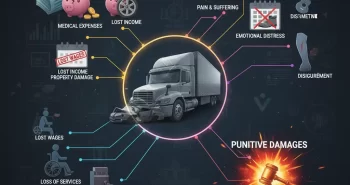
Accurately determining damages is more than adding up hospital bills and repair estimates. Truck accidents can result in significant damages, including lost wages, reduced earning capacity, and ongoing documented expenses. You may also face intangible losses, like emotional distress and diminished quality of life.
These damages are often greater than those seen in typical auto accidents because of the size and force involved in heavy truck collisions.
To calculate fair compensation, begin by listing your measurable financial costs, such as medical expenses and lost wages. Preserve itemized bills and receipts showing accident-related charges and out-of-pocket costs. Then, factor in items like pain and suffering or emotional distress, keeping in mind that these are often harder to quantify. For deeper insight into how damages typically work, you might check references such as what are damages in truck accident cases.
Insurance adjusters might attempt to undervalue these less tangible losses. However, our observation is that by documentation and, when appropriate, expert analysis, damages can carry significant weight in negotiations or trial.
Negotiating a settlement or filing a lawsuit
After you have built a compelling case, the next step often involves back-and-forth discussions with the at-fault party’s insurer. A settlement offer might emerge quickly, but do not feel pressured to accept the first figure. We advise reviewing documentation supporting your damages (bills, wage records, repair estimates, and any supported projected costs) with your attorney before making a decision. Settlement sums can vary widely, and you do not want to overlook critical costs.
In some situations, negotiations fail. Perhaps the trucking company’s insurer flatly denies liability, or an offer is unreasonably low. You can then explore a truck accident settlement through more intensive mediation or proceed with a formal truck accident lawsuit. Litigation can lead to a court verdict, although it often extends the timeline. We know the thought of going to court can be daunting, but in certain cases, it is the most effective path to securing the maximum compensation you truly deserve.
Timeline how long a truck accident claim takes
One question we often hear is: how long will it take for everything to resolve? The answer varies. Some claims end in just a few months, especially if liability is clear and injuries are straightforward. More complex cases can last a year or longer, particularly when multiple defendants are involved or when the injuries require extensive medical treatment.
Throughout the timeline, your case may be compared with prior truck collision outcomes to estimate possible settlement ranges.
The negotiation phase alone can stretch out if each side disputes the facts or the cost of damages. Court scheduling can introduce further delays, too. Throughout the process, though, having a well-documented file and an informed plan can speed up decisions. Each piece of evidence you compile from the start helps create momentum. The most important advice we can give is to remain patient, respond promptly to requests from your lawyer or insurance company, and keep meticulous records of new medical bills or changes in your condition.
Getting help from Legal Claim Assistant
Navigating how to file a truck accident claim does not have to be a solitary task. Our experience suggests that professional attorney can reduce stress and help you avoid costly mistakes. These teams specialize in gathering paperwork, verifying documents, and ensuring you never miss key deadlines.
We often recommend these services to individuals who feel overwhelmed by piles of medical bills or complicated insurance language. Legal claim assistant can also connect you with an appropriate attorney if you have not yet hired one. They handle many of the administrative tasks, allowing you to stay focused on your healing and family responsibilities. If you want to be matched with a qualified professional or simply want more legal guidance, we encourage you to explore how these helpers can streamline your road to recovery and compensation.
Ultimately, understanding the full picture of your truck accident claim is about recognizing your rights, knowing what steps to take, and having reliable partners by your side. We are here to guide you, offering clarity at each turn and helping you forge the best path forward under challenging circumstances. You do not have to go through this alone, and we hope that by outlining the process in a straightforward way, you feel confident taking your next steps.
No Win, No Fee. Let the Best Truck Accident Attorneys Fight for your Compensation!