


Key Takeaways:
Surviving family members can file a wrongful death lawsuit after a drunk driving accident, even if the driver faces criminal charges or is acquitted.
Compensation can cover medical expenses, funeral and burial costs, lost income, emotional suffering, and punitive damages for reckless behavior.
Hiring an experienced wrongful death attorney can help families understand legal options, meet deadlines, gather evidence, and improve financial recovery.
Who Can File a Wrongful Death Lawsuit After a Drunk Driving Accident
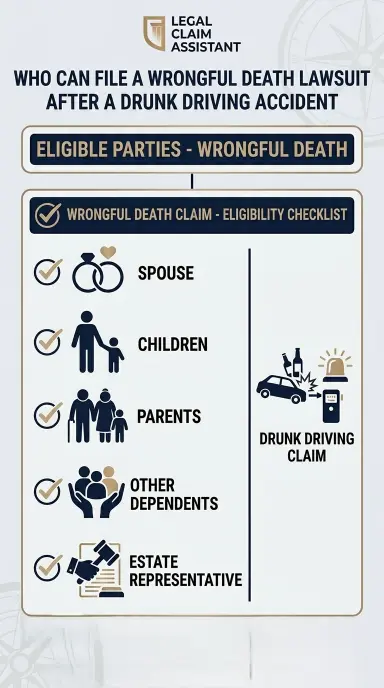
Eligible parties include the spouse, children, parents, financial dependents, and the estate representative. Understanding who can file is important to protect your rights and seek financial compensation for funeral and burial costs, lost income, medical expenses, and intangible losses like emotional suffering.
Deceased person’s surviving spouse: The spouse is usually first in line to file a wrongful death case. They can seek compensation for loss of companionship, financial support, and emotional distress.
Children of the deceased: Dependent children can file to recover lost income, future financial support, and compensation for suffering caused by losing a parent.
Parents: If the deceased was a minor, or if no spouse or children exist, parents may be eligible to file a wrongful death claim to seek financial relief and provide for surviving relatives.
Other financial dependents: In some states, putative spouses, stepchildren, or close relatives who relied on the deceased for support may be allowed to file a civil wrongful death case. These rules also apply in nursing home wrongful death cases, where dependents can claim damages under similar state laws.
Personal representative of the deceased person’s estate: Many jurisdictions require that only the personal representative can formally file the lawsuit on behalf of the deceased’s estate, ensuring that compensation is properly distributed.
Filing deadlines vary by state, usually between one and three years. Some cases have shorter or longer deadlines depending on the state and facts. Missing this deadline may prevent a successful wrongful death claim, even if the accident clearly caused the deceased person’s death. Consulting a wrongful death attorney can help surviving family members understand their legal options, gather evidence such as police reports and witness statements, and ensure the civil claim is filed correctly.
Understanding Civil vs Criminal Cases in Drunk Driving Fatalities
After a fatal drunk driving crash, families often face both criminal and civil processes. Understanding the difference helps you seek financial compensation and understand your legal options.
Criminal cases focus on punishing the at-fault party. Charges such as DUI homicide or vehicular manslaughter are filed in criminal court by prosecutors. Surviving family members do not control criminal charges, but they may provide information such as reports and witness details to investigators or prosecutors. Criminal cases require proof beyond a reasonable doubt, which is a high standard.
Civil wrongful death cases focus on financial recovery for surviving loved ones. Families can file a civil suit to provide financial compensation for medical expenses, funeral and burial costs, lost income, emotional suffering, and in some cases, punitive damages if the defendant acted recklessly or intentionally. Civil claims have a lower burden of proof, “preponderance of evidence,” meaning the family can win even if the driver is acquitted in criminal court.
Aspect | Criminal Case | Civil Wrongful Death Case |
|---|---|---|
Purpose | Punish the at-fault party | Provide financial compensation to family |
Filed by | Prosecutor | Surviving family members / estate representative |
Burden of Proof | Beyond a reasonable doubt | Preponderance of evidence |
Possible Outcome | Jail, fines, probation | Funeral expenses, lost income, punitive damages |
Influence on the Other | Conviction strengthens civil case | Civil verdict does not affect criminal charges |
Even if the driver faces criminal charges and is acquitted, surviving relatives can still file a civil claim. Criminal convictions can make it easier to prove negligence, but they are not required for a successful wrongful death lawsuit.
Common Damages in Drunk Driving Wrongful Death Cases
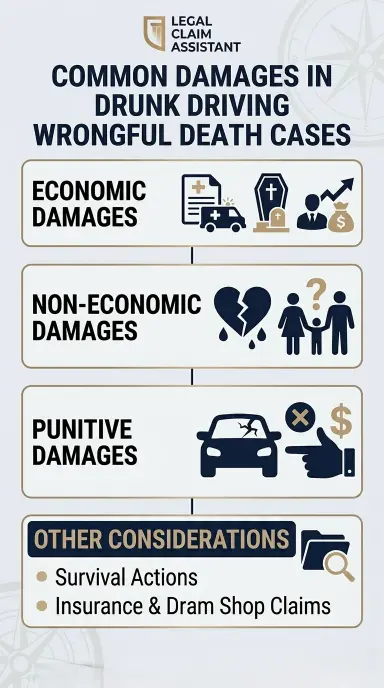
Families who lose a loved one in a drunk driving accident can seek compensation for both financial and emotional losses. A successful wrongful death claim often includes multiple types of damages:
Economic Damages
Medical bills before death: Covers emergency care, hospital treatment, and medical expenses incurred after the accident caused the deceased person’s injuries.
Funeral and burial costs: Compensation for funeral expenses, burial costs, and related services.
Lost income and future wages: Reimbursement for the deceased person’s lost earnings, including potential future income that would have supported surviving family members.
Non-Economic Damages
Emotional distress and mental anguish: Compensation for emotional suffering by surviving relatives due to the sudden loss of life.
Loss of companionship and consortium: Covers the intangible impact of losing a spouse, parent, or child, including loss of guidance, care, and support.
Punitive Damages
Awarded if the drunk driver acted recklessly or with gross negligence, such as driving under the influence.
Intended to punish the at-fault party and deter similar behavior.
Other Considerations
Survival actions: Some states allow claims for the deceased person’s pain and suffering before death.
Insurance and Dram Shop claims: Compensation may be supplemented through the driver’s insurance or by holding bars or restaurants liable for over-serving alcohol.
Families seeking justice should consult a wrongful death attorney to fully understand wrongful death laws under Texas law or other state regulations. A lawyer can evaluate economic and non-economic damages, identify potential defendants, and guide families through the claim process, often offering a free consultation to discuss legal options.
How Wrongful Death Lawsuits Differ from Criminal Drunk Driving Cases
Wrongful death lawsuits differ from criminal cases because civil claims provide financial compensation to families, while criminal cases punish the driver. Understanding wrongful death requires knowing the difference between civil and criminal liability. Both processes may follow a fatal drunk driving crash, but they serve distinct purposes.
Criminal drunk driving cases focus on punishing the at-fault party. Charges like DUI homicide or vehicular manslaughter are handled in criminal court, with prosecutors seeking jail time, fines, or probation. Families do not file criminal charges but can assist by providing police reports, witness statements, and other evidence to support the case. A conviction requires proof beyond a reasonable doubt, a high legal standard.
Civil wrongful death cases aim to provide financial compensation for surviving loved ones. Families can file a civil claim to recover medical expenses, funeral costs, lost income, and intangible losses such as emotional suffering or loss of companionship. Civil cases require a lower burden of proof preponderance of the evidence so families can seek justice and compensation even if the driver is acquitted in criminal court.
Civil claims are independent of criminal prosecution, although a criminal conviction can strengthen a wrongful death case by showing clear evidence of recklessness. Surviving family members can pursue damages under Texas law regardless of the outcome in criminal court. Consulting a wrongful death attorney ensures families understand their legal options, gather necessary evidence, and pursue maximum compensation for the life lost in a drunk driving accident.
Steps to File a Wrongful Death Claim Against a Drunk Driver
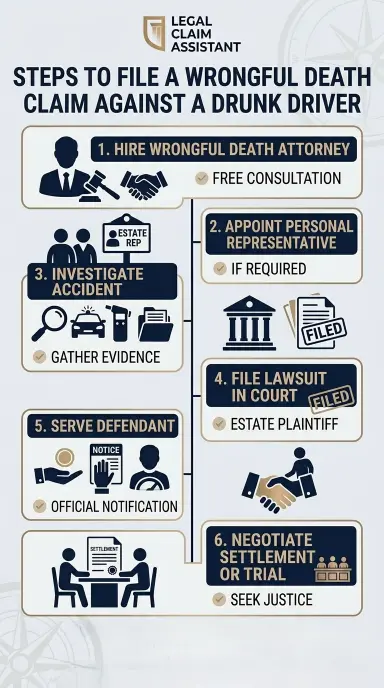
Filing a wrongful death claim after losing a loved one in a drunk driving accident can be complex. Following a clear, step-by-step process helps surviving family members seek compensation and justice efficiently.
Hire an experienced wrongful death attorney: An attorney can help explore legal options, evaluates the accident caused by the drunk driver, and guides families through civil wrongful death cases. Most attorneys offer a free consultation to explain potential claims and damages.
Appoint a personal representative if required by state law: In many jurisdictions, only the deceased person’s estate representative can formally file a wrongful death lawsuit. This helps ensure damages are distributed correctly to surviving relatives.
Investigate the accident: Gather evidence such as police reports, witness statements, BAC test results, and other documentation that proves the defendant’s reckless behavior or alcohol involvement.
File the lawsuit in the appropriate court: The personal representative files the civil claim, naming the estate as the plaintiff and the at-fault driver as the defendant.
Serve the defendant: Officially notifies the drunk driver of the legal action, giving them an opportunity to respond.
Negotiate settlements or proceed to trial: Most drunk driving cases settle before trial, but litigation may be necessary if liability, negligence, or damages are disputed. A skilled attorney will advocate for fair compensation.
Following these steps under Texas law or other state statutes ensures families act within deadlines and protect their right to financial recovery for funeral expenses, lost income, medical bills, and emotional suffering.
Average Settlement and Factors Affecting Compensation
The compensation in a wrongful death case caused by a drunk driver varies widely. Typical settlements range from $500,000 to over $1 million, depending on the severity of negligence, financial contributions of the deceased, and the impact on surviving loved ones.
Factors that influence settlements:
Severity of negligence or recklessness: Drivers who were extremely reckless, such as driving the wrong way or with a high BAC, can increase the potential payout.
Economic contributions of the deceased: Lost income, benefits, and future earnings play a major role in determining compensation.
Emotional impact on surviving family members: Courts consider the suffering of spouses, children, and parents in non-economic damages.
Availability and strength of evidence: Police reports, witness statements, medical records, and other documentation strongly influence the outcome.
Insurance policy limits: The driver’s insurance often caps the maximum recovery.
Dram Shop claims: Families may seek additional compensation if bars or restaurants served alcohol recklessly to the at-fault driver.
In some cases, one-third of the settlement may go to legal fees, but working with a skilled wrongful death attorney helps families pursue fair financial recovery and pursue punitive damages when the defendant acted recklessly.
Why Legal Representation Matters in Drunk Driving Wrongful Death Cases
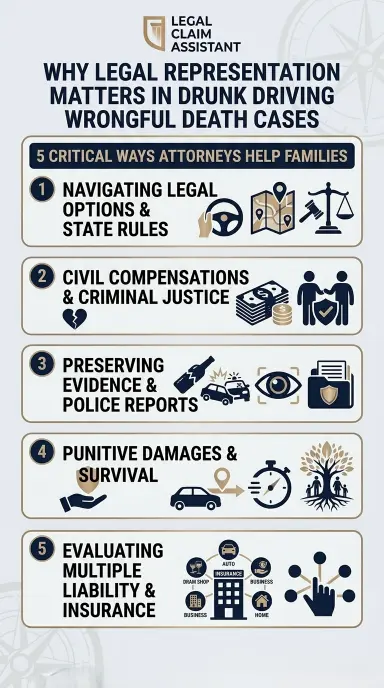
Working with an experienced law firm is crucial when pursuing a wrongful death claim after a drunk driving accident. Attorneys help families understand legal options, navigate complex state rules, and help ensure all potential claims are evaluated.
A skilled wrongful death attorney distinguishes between civil and criminal cases, allowing families to seek both financial compensation and justice. Legal representation ensures that filing deadlines are met, evidence such as police reports and witness statements is properly collected, and insurance companies are less likely to minimize payouts
Attorneys also guide families on claims for punitive damages, survival actions, and multiple liability scenarios, including insurance and Dram Shop claims. Most wrongful death attorneys offer a free consultation and work on a contingency basis, meaning families can pursue compensation without upfront costs while focusing on recovery and grieving.
Frequently Asked Questions About Wrongful Death from Drunk Drivers
When a loved one dies in a drunk driving accident, families often have urgent legal questions. Understanding wrongful death under Texas law or your state’s rules can help you take timely action and protect your rights.
Can I file a wrongful death lawsuit if the driver is acquitted?
Yes. Civil claims have a lower burden of proof, called preponderance of the evidence so families may still be able to seek compensation even if the driver is found not guilty.
What damages can I recover?
Families may recover medical expenses before death, funeral and burial costs, lost income, emotional suffering, and in some cases, punitive damages if the driver acted recklessly or intentionally.
Who can file the lawsuit?
Eligible parties typically include the deceased person’s surviving spouse, children, parents, or the personal representative of the estate, depending on state law.
How long do I have to file?
Deadlines vary by state, usually ranging from one to three years from the accident or the deceased person’s death. Filing within this statute of limitations is essential to maintain your right to compensation.
Can I pursue a wrongful death claim if the drunk driver had no insurance?
Yes. You can still pursue a wrongful death claim if the driver has no insurance. Compensation may come from the driver’s assets, underinsured motorist coverage, or Dram Shop claims.
Speak With a Wrongful Death Lawyer Today
If you lost a loved one in a drunk driving accident, speaking with a wrongful death attorney can help you seek justice and financial compensation. Attorneys can explain your legal options, guide you through filing a civil claim, and help navigate the differences between civil and criminal cases.
A skilled lawyer will work to pursue all potential damages, including medical expenses, funeral and burial costs, lost income, emotional suffering, and punitive damages if the driver acted recklessly. Many wrongful death attorneys offer a free consultation, allowing families to understand the strength of their case and the compensation they may be entitled to without any upfront cost.
Working with a knowledgeable attorney ensures that deadlines under state law are met, evidence such as police reports and witness statements is properly collected, and insurance companies cannot minimize payouts. Surviving family members can focus on recovery while legal experts handle the complex process of filing a wrongful death lawsuit and seeking maximum compensation.
You Deserve Justice. Let Us Help.
Speak with a trusted Wrongful Death Attorney who will stand by your side, protect your rights, and fight for the compensation you deserve.
No Win, No Fee. Let the Best Wrongful Death Attorneys Fight for your Compensation!

Under 1 Minute

100% Free

Expert-Reviewed

Private & Secure
© 2025 Legal Claim Assistant. All Rights Reserved.
Terms of Service | Privacy Policy | Contact Us | Marketing Partners
Related Article

Share this article:


