


Key Takeaways:
Wrongful death negligence happens when someone dies because another person failed to use reasonable care. Families can file a civil claim to recover financial compensation.
Proving negligence requires evidence showing duty, breach, causation, and damages, including accident reports, medical records, witness statements, and expert testimony.
Consulting a wrongful death negligence lawyer early helps with investigation, deadlines, and building a stronger case.
What Is Wrongful Death Negligence?
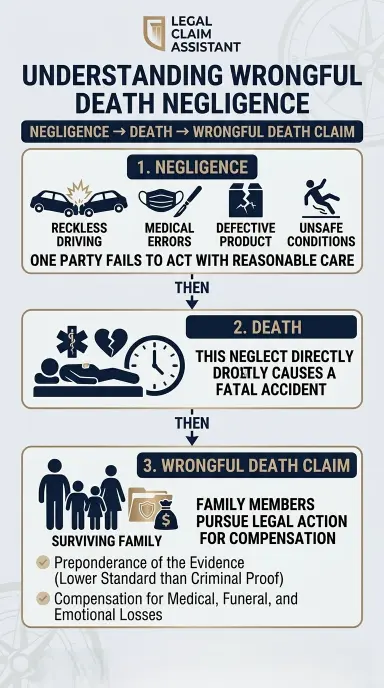
Wrongful death negligence occurs when a person’s death results from someone else’s negligent or intentional act. Negligence means a person or organization failed to act with reasonable care and that failure caused harm. When that lack of care leads directly to someone’s death, surviving family members may pursue a wrongful death action to seek financial compensation for their losses.
Many wrongful death cases arise from situations where a defendant failed to meet basic safety responsibilities.
Examples include:
Reckless driving that violates traffic laws, medical negligence such as surgical errors or wrong medication, defective products that cause fatal injuries, or unsafe conditions that lead to fatal accidents. In these situations, the law allows family members to pursue legal action because the death occurred due to another party’s failure to act responsibly.
In civil court, the legal standard used to evaluate these claims is called the preponderance of the evidence. This means the plaintiff must show it is more likely than not that the defendant caused the death. This standard is lower than the proof required in a criminal case, which requires proof beyond a reasonable doubt.
Families who lose a loved one because of medical malpractice, car accidents, dog attacks, or other negligent acts may seek compensation through a legal claim. A wrongful death lawsuit may result in compensation for medical expenses, funeral costs, lost income, and other damages. Courts may also recognize non-economic damages such as emotional suffering, loss of companionship, and the sudden loss of financial support.
Key Elements of a Wrongful Death Negligence Claim
To succeed in a wrongful death negligence claim, the plaintiff must prove several key elements during the legal process. Courts carefully examine these elements to determine whether the defendant should be held liable for the death and whether the surviving family members are entitled to recover damages.
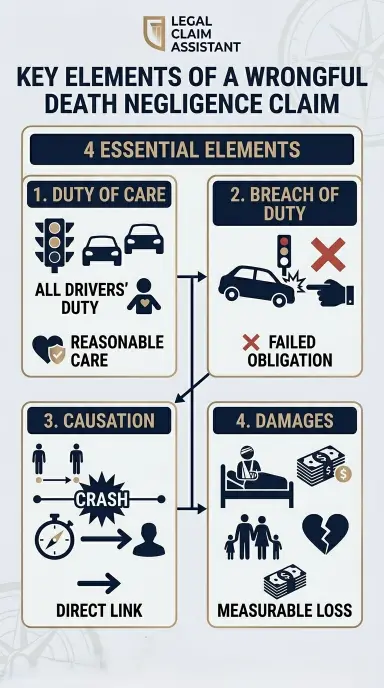
Duty of care
The first element is establishing that the defendant owed a duty of care to the deceased person. A duty of care exists when someone has a legal responsibility to act in a reasonably safe manner. Drivers must follow traffic laws and avoid reckless driving, doctors must provide treatment that meets accepted medical standards, and manufacturers must ensure their products are safe. When the defendant owed this legal duty to the victim, the first requirement of a wrongful death claim is satisfied.
Breach of duty
The second element requires proof that the defendant committed a breach of duty. A breach occurs when the defendant fails to act with reasonable care or violates legal obligations. For example, a drunk driver who ignores traffic laws, a medical professional who commits serious medical errors, or a company that releases a defective product may be responsible for a defendant’s breach. This failure to meet the duty of care forms the foundation of many wrongful death cases.
Causation
The plaintiff must then show that the defendant’s actions directly caused the person’s death. Courts often examine two aspects of causation, the actual cause and the proximate cause. The actual cause focuses on whether the fatal injury would have occurred without the defendant’s conduct. Proximate cause determines whether the death was a foreseeable result of the negligent behavior. Evidence such as medical records, accident reconstruction, and expert testimony often helps establish this connection.
Damages
Finally, the plaintiff must demonstrate that the surviving family members suffered measurable damages as a result of the death. These damages may include economic damages such as medical bills, funeral and burial costs, lost wages, lost income, and the loss of household services. Courts may also award non economic damages for emotional suffering and loss of companionship experienced after a loved one’s death.
In some cases, courts may also consider punitive damages when the defendant’s conduct involved gross negligence or intentional acts. These damages are intended to punish particularly dangerous behavior and deter similar conduct in the future.
Common Scenarios Leading to Wrongful Death Due to Negligence
Wrongful death due to negligence and negligent death claims can occur in many situations where a person fails to act with reasonable care and someone’s death results.
Many wrongful death cases arise from preventable incidents where a responsible party may be found liable for the damages suffered by surviving family members.
Car accidents: Car accidents are one of the most common causes of wrongful death claims. Negligent behavior such as distracted driving, reckless driving, or failure to follow traffic laws can cause deadly collisions. When a driver’s negligence leads to a fatal crash, surviving families may pursue legal action to recover damages for the losses suffered.
Drunk drivers: Accidents caused by a drunk driver often lead to serious injuries and fatalities. Driving under the influence significantly increases the risk of fatal collisions. When alcohol causes a fatal crash, the driver may be held responsible.
Medical negligence: Medical negligence can occur when healthcare providers fail to meet accepted medical standards. Common examples include surgical errors, misdiagnosis, delayed diagnosis, or failure to provide proper follow-up care. In some cases, families may file a medical malpractice lawsuit if medical negligence directly caused a patient’s death.
Dog attacks: Dog attacks can lead to fatal injuries when owners fail to control or restrain dangerous animals. If a dog owner knew or should have known that the animal posed a risk and failed to take proper precautions, they may be held responsible for damages resulting from the attack.
Defective products: A defective product can cause fatal injuries when it is poorly designed, improperly manufactured, or lacks adequate safety warnings. Manufacturers, distributors, or retailers may be held liable if an unsafe product causes someone’s death.
Workplace accidents: Employer negligence in workplace safety protocols can lead to fatal accidents. Unsafe working conditions, lack of safety equipment, or failure to follow industry regulations can result in serious incidents. Families may pursue compensation when workplace negligence contributed to a worker’s death.
In each of these scenarios, compensation may vary depending on the economic and non economic losses suffered by survivors. Courts often consider damages such as medical bills, funeral expenses, lost income, and emotional harm when determining the compensation awarded.
How to File a Wrongful Death Claim for Negligence
Filing a wrongful death claim involves several legal steps that allow surviving family members to pursue compensation for the losses caused by someone else’s negligence. The legal process typically begins soon after the death and must be completed within the statute of limitations established by state law.
Consult a wrongful death lawyer
The first step is to speak with a wrongful death attorney who can evaluate the circumstances surrounding the death. Many law firms offer a free consultation to review the facts and determine whether a valid claim exists. An attorney can explain the legal options available and identify the parties who may be responsible.Gather and preserve evidence
Collecting evidence is critical to building a strong claim. Attorneys often assist families with collecting evidence such as accident reports, medical records, witness statements, and other documentation related to the incident. This information helps establish liability and demonstrates the damages suffered by the family.File the wrongful death lawsuit
State law determines who can file the claim. In many cases, the personal representative of the estate files the lawsuit, while some states allow close family members to file directly. This legal action formally begins the case in civil court and identifies the defendant believed to be responsible for the death.Discovery phase
During discovery, both sides exchange evidence and gather additional information about the incident. This stage may involve reviewing documents, conducting depositions, and analyzing expert reports. Discovery includes exchanging documents, taking depositions, and disclosing expert reports. Both sides use this stage to gather evidence required for trial or settlement.Settlement negotiations or trial
Many wrongful death cases resolve through settlement negotiations at any stage of the case, including before or during trial preparation. If a settlement is not reached, the case may proceed through pre-trial motions and then trial, where a judge or jury decides liability and damages.
Most wrongful death lawyers work on a contingency fee basis, meaning fees are paid only if compensation is recovered. Case costs may also apply depending on the agreement. This allows families to pursue justice without paying upfront legal costs while focusing on the emotional impact of their loss.
Compensation and Damages in Wrongful Death Negligence Cases
Compensation helps families recover financial and emotional losses after an untimely death. When a court determines that another party’s negligence caused the death, the surviving family members or the decedent’s estate may recover damages through a wrongful death claim.
The total compensation awarded depends on the circumstances of the case and the extent of the losses suffered.
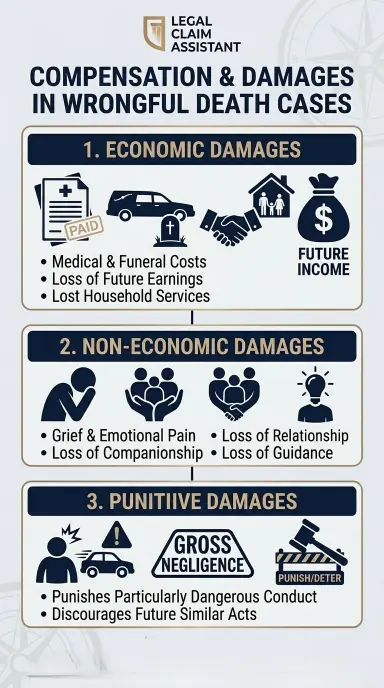
Economic damages
Economic damages compensate families for measurable financial losses resulting from the death. These damages may include medical bills related to treatment before the death, funeral expenses, burial costs, and the loss of the deceased person’s future income. Courts may also consider the value of lost household services and financial support that the deceased would have provided to the family.
Non-economic damages
Non-economic damages address the emotional impact of the death. Surviving family members may experience grief, emotional suffering, and the loss of companionship and guidance after a loved one dies. These damages cover emotional losses that cannot be measured in money.
Punitive damages
In some cases, courts may award punitive damages when the defendant’s conduct involved gross negligence or intentional harm. These damages are intended to punish particularly dangerous behavior and discourage similar actions in the future. For example, cases involving reckless conduct or extreme disregard for safety may qualify for punitive damages.
The amount of compensation awarded in wrongful death cases depends on several factors. Courts often review the victim’s income, the level of financial dependency among family members, and the severity of the losses suffered after the death. Proper documentation such as medical bills, financial records, and employment information can help establish the full impact of the loss.
How Wrongful Death Negligence Lawyers Prove Fault
Wrongful death negligence lawyers play a central role in gathering evidence, analyzing the circumstances of the death, and building a legal case that shows the defendant’s negligence caused the fatal outcome.
Attorneys begin by collecting evidence that explains how the incident occurred. This evidence may include accident reports prepared by law enforcement, medical records documenting the injuries and treatment before the death, witness statements from individuals who saw the incident, and expert testimony from professionals who can explain how the fatal event occurred.
To succeed in court:
A wrongful death attorney must demonstrate several legal elements. First, the attorney must show that the defendant owed a duty of care to the victim. Next, the lawyer must prove that the defendant breached that duty by acting negligently or failing to follow safety standards. The attorney must then establish causation by showing that the defendant’s actions directly caused the death. Finally, the case must demonstrate the damages suffered by the surviving family members.
Even when criminal charges are filed against the responsible party, a civil wrongful death lawsuit may still proceed separately. The goal of the civil case is to hold the defendant financially accountable and provide compensation to the family.
By presenting clear and compelling evidence, wrongful death negligence lawyers work to prove that the defendant was responsible for the loved one’s death and help families seek justice through the legal system.
Frequently Asked Questions About Wrongful Death Negligence
People often have questions about how wrongful death negligence claims work. The answers below address common concerns about proving negligence, legal responsibility, and compensation for families after a wrongful death.
What is the difference between negligence and wrongful death?
Negligence means failing to use reasonable care and causing harm. Wrongful death occurs when negligence causes a person dies as a result of another party’s actions. When someone’s careless actions lead to his or her death, surviving family members may file a civil claim to seek compensation for the losses suffered.
How hard is it to prove negligence in a wrongful death case?
Proving negligence requires clear evidence showing that the defendant owed a duty of care, breached that duty, caused the death, and created damages for the surviving family members. Evidence often includes accident reports, medical records, witness statements, and expert testimony. This evidence helps establish how the defendant’s actions caused the fatal outcome.
What is the average payout for medical negligence resulting in death?
There is no fixed payout amount for medical negligence cases that result in death. Compensation varies depending on the economic and non economic losses, state law, and the specific facts of the case. Some cases may result in larger settlements depending on the facts and evidence.
Is wrongful death a negligence claim?
Yes. Most wrongful death lawsuits are based on negligence, meaning the death occurred because someone failed to act with reasonable care. However, some cases may involve intentional acts or a criminal act that also create liability if those actions resulted in a person’s death.
Who can file a wrongful death negligence claim?
State laws determine who can file a wrongful death claim. In most cases, eligible parties include the surviving spouse, children, parents, or the personal representative of the deceased person’s estate.
Speak with a Wrongful Death Negligence Lawyer
Families who believe negligence caused a loved one’s death should consider speaking with a wrongful death negligence lawyer. An attorney can review the circumstances surrounding the incident and determine whether a legal claim may be available.
Lawyers investigate the incident by reviewing reports, medical records, and other evidence related to the events that caused the death. This investigation helps determine who may be responsible and whether negligence directly caused the death.
Attorneys also evaluate the damages suffered by surviving family members. This includes calculating economic losses such as medical expenses, funeral costs, and lost income, along with non-economic damages related to emotional suffering and loss of companionship.
A wrongful death negligence lawyer manages the legal process from start to finish. This includes preparing the claim, filing court documents, negotiating with insurance companies, and representing the family in court if the case proceeds to trial.
Early legal guidance helps ensure the claim follows the correct legal procedures and complies with state statutes. By building a strong case and presenting clear evidence, an attorney works to help families pursue the compensation they may be entitled to recover.
You Deserve Justice. Let Us Help.
Speak with a trusted Wrongful Death Attorney who will stand by your side, protect your rights, and fight for the compensation you deserve.
No Win, No Fee. Let the Best Wrongful Death Attorneys Fight for your Compensation!

Under 1 Minute

100% Free

Expert-Reviewed

Private & Secure
© 2025 Legal Claim Assistant. All Rights Reserved.
Terms of Service | Privacy Policy | Contact Us | Marketing Partners
Related Article

Share this article:


