


Key Takeaways:
Wrongful death cases allow family members or a personal representative to seek compensation. This can include medical expenses, funeral costs, lost income, and emotional suffering.
Filing a wrongful death lawsuit requires proving negligence or intentional wrongdoing. It also involves gathering evidence like medical records and following state filing deadlines.
An experienced wrongful death attorney can help with legal procedures, proving liability, and building a stronger case.
What Is Wrongful Death Litigation Under Wrongful Death Law
Wrongful death litigation is a civil process used to seek compensation when someone dies due to negligence or intentional harm. These wrongful death lawsuits allow surviving family members to hold the responsible party legally accountable for the deceased’s death. Wrongful death cases involve deaths caused by negligence or intentional actions.
Common examples include:
Automobile accidents, medical malpractice cases, workplace accidents caused by employer negligence, defective products, and intentional harm. The original wrongful death statutes in the U.S. were designed to benefit widows and children who relied on the deceased for financial support, highlighting the law’s purpose to provide financial protection for dependents.
Wrongful death law in each state defines who can file a claim, what damages can be recovered, and how litigation proceeds. Because state laws and wrongful death statutes vary, legal guidance from an experienced wrongful death attorney is often essential.
Proper legal representation helps surviving family members to pursue compensation, recover damages for medical expenses, funeral costs, lost wages, and emotional distress, and seek justice for the deceased person’s wrongful death.
Who Can File a Wrongful Death Claim and Begin a Wrongful Death Action
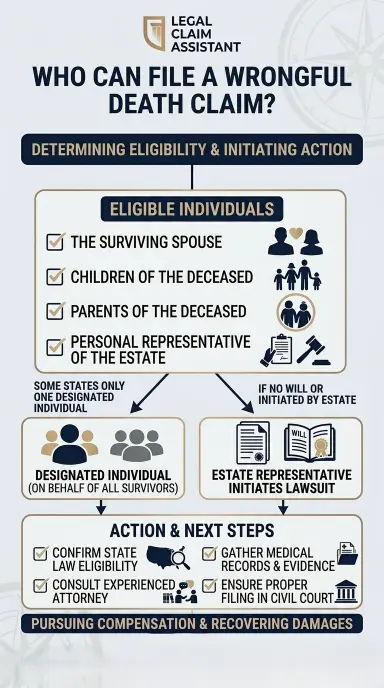
State laws determine who is legally authorized to file a wrongful death claim. Individuals who may have legal standing include:
The decedent’s surviving spouse
Children of the deceased
Parents of the deceased
The personal representative of the deceased’s estate
In some states, only one designated individual can file the wrongful death action on behalf of all decedent’s survivors. If the deceased did not leave a will, the personal representative of the deceased’s estate may initiate the lawsuit.
Before filing, you must confirm eligibility under state law. An experienced wrongful death attorney can guide family members through the process, help gather medical records and evidence of the defendant’s negligence, and ensure that the legal action is properly filed in civil court.
Filing a wrongful death claim correctly is critical to pursue compensation, recover damages for medical bills, funeral expenses, lost financial support, and non-economic damages such as emotional distress and loss of companionship.
Common Situations That Lead to Wrongful Death Lawsuits
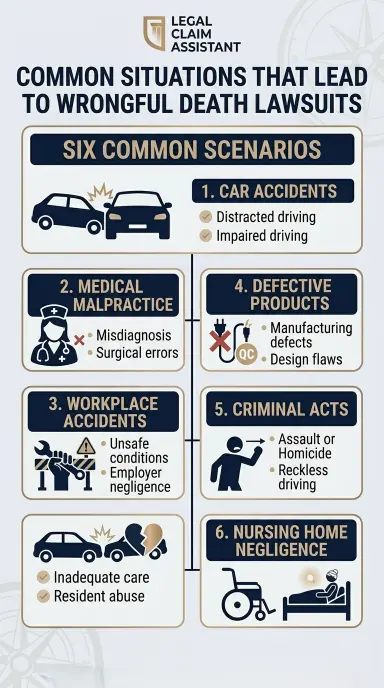
Wrongful death lawsuits can arise from a variety of fatal incidents caused by another party’s negligence or wrongful act. Common situations include:
Car accidents: Driver negligence, speeding, distracted driving, or impaired driving can lead to fatal injuries. Car accidents often lead to wrongful death claims when another driver is at fault.
Medical malpractice: Healthcare providers may be held liable if they fail to meet the accepted standard of care, leading to a patient’s death. Medical malpractice cases often involve compelling evidence such as medical records to prove negligence.
Workplace accidents: Employer negligence or unsafe working conditions in high-risk industries can cause fatal injuries. Personal injury attorneys often assist decedent’s survivors in pursuing compensation for lost wages, medical expenses, and emotional distress.
Defective products: Manufacturers or distributors may be held liable if a defective product causes a fatal incident.
Criminal acts: Homicide, assault, or other intentional acts can result in a wrongful death civil claim, even if criminal charges are filed and a criminal trial is ongoing.
Nursing home negligence: Failure to provide proper care to vulnerable residents can lead to the deceased person’s death, giving family members the right to file a wrongful death lawsuit.
Car accidents are among the most frequent types of wrongful death cases, often resulting from driver negligence or reckless behavior
The Legal Elements Required to Prove a Wrongful Death Case
To successfully pursue a wrongful death claim, the plaintiff must prove four key elements of negligence:
Legal Element | Explanation | Examples / Details |
|---|---|---|
Duty of Care | The defendant had a legal duty to act safely toward the deceased. | Following traffic laws, maintaining safe property, providing competent medical care, ensuring safe workplaces. |
Breach of Duty | The defendant failed to act with reasonable care. | Unsafe driving, medical errors, employer negligence, defective products, intentional harm. |
Causation | The defendant’s actions directly caused the death. | Compelling evidence such as medical records, accident reports, or expert testimony links the wrongful act to fatal injuries. |
Damages | The death caused financial or emotional losses. | Economic damages: medical expenses, lost wages, funeral costs; Non-economic damages: emotional distress, loss of companionship; Punitive damages in cases of reckless or intentional conduct. |
The burden of proof lies with the plaintiff, and unlike criminal cases, civil wrongful death claims require a preponderance of evidence rather than proof beyond a reasonable doubt.
Damages and Fair Compensation in Wrongful Death Litigation
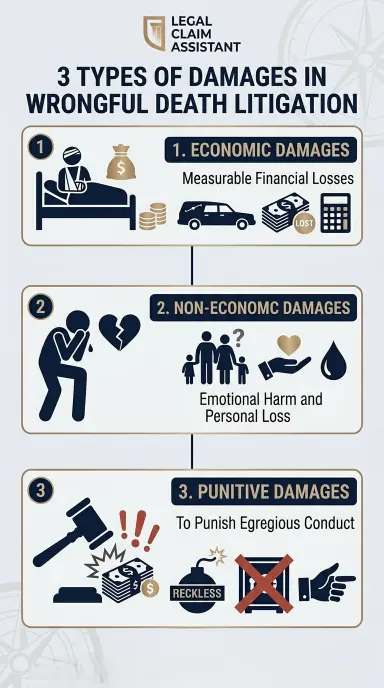
Wrongful death lawsuits allow surviving family members to pursue financial compensation for losses resulting from a decedent’s death. Damages in these cases are generally divided into three categories:
Economic Damages
These cover measurable financial losses caused by the fatal incident. Examples include:
Medical bills and expenses incurred before the person’s death
Funeral costs and burial expenses
Lost income and financial support the deceased would have provided to blood relatives
Non-Economic Damages
Non-economic damages provide compensation for the long-term effects of the trauma associated with the decedent’s death. These cover emotional harm and personal loss. Examples include:
Grief and emotional suffering experienced by surviving family members
Loss of companionship or parental guidance
The long-term impact of losing a loved one on the family’s well-being
Punitive Damages
Courts may award punitive damages when the defendant’s conduct was especially reckless or intentional, beyond ordinary negligence. Punitive damages may be awarded in wrongful death cases when the defendant’s actions were particularly egregious or intentional.
Wrongful death settlements vary widely depending on the circumstances of the fatal injury, the decedent’s estate, and the losses suffered by surviving family members. Wrongful death settlements can vary significantly, with amounts ranging from tens of thousands to millions of dollars.
Why Legal Guidance Is Important in Wrongful Death Litigation
Legal guidance is essential in wrongful death litigation because these cases involve complex legal procedures, strict filing deadlines, and the need to prove liability with strong evidence. Surviving family members often face statutes of limitations, detailed documentation requirements, and negotiations with insurance companies. Without legal representation, plaintiffs may struggle to build a strong case, which can lead to reduced compensation or even dismissal.
A wrongful death lawyer can help guide the case and explain the legal process. An experienced wrongful death attorney can guide the case from start to finish, ensuring that all legal strategies are effectively executed.
Attorneys help gather medical records, evidence of the defendant’s negligence, and compelling documentation of damages. They also assist in filing a legal claim on behalf of the decedent’s estate or surviving family members and in negotiating settlements with insurance companies and opposing counsel.
Without legal representation, plaintiffs risk underestimating damages, missing critical filing deadlines, or failing to establish liability. Hiring an experienced attorney significantly improves the chances of recovering full financial compensation and achieving a fair wrongful death settlement for the deceased person’s estate and surviving blood relatives.
Frequently Asked Questions About Wrongful Death Litigation
This FAQ section answers common questions about wrongful death litigation, including how claims work, filing deadlines, and what families must prove to recover compensation. Use these answers to understand your legal options and what to expect during the process.
What is wrongful death litigation?
Wrongful death litigation is a civil process used to seek compensation after a wrongful death. These lawsuits allow surviving family members to seek financial recovery for medical expenses, funeral costs, lost income, and emotional distress caused by the victim’s death.
How long do you have to file a wrongful death lawsuit?
The statute of limitations for filing a wrongful death claim varies by state. In many states, lawsuits must be filed within a certain time period, often two to three years, but the exact deadline varies by state and case type. Filing within this period is critical to preserve the right to pursue compensation.
Can wrongful death lawsuits be filed alongside criminal charges?
Yes. Wrongful death lawsuits are civil cases and may proceed even if criminal charges are filed against the responsible party. Civil claims focus on recovering financial compensation for the decedent’s surviving family members, while criminal cases address punishment for the defendant’s misconduct.
How much compensation can families receive?
Wrongful death settlements vary widely. Awards depend on the severity of financial losses, emotional distress, and the circumstances of the fatal incident. Compensation may cover medical bills, funeral costs, lost wages, and non-economic damages such as grief and loss of companionship.
What must be proven in a wrongful death lawsuit?
To win a wrongful death lawsuit, the plaintiff must prove four key elements. These include a duty of care owed by the defendant, a breach of that duty through negligence or misconduct, a direct connection between the breach and the person’s death, and measurable damages suffered by surviving family members such as medical expenses, lost income, and funeral costs.
Speak With a Wrongful Death Litigation Lawyer
If you believe a loved one’s death was caused by someone else’s negligence, speaking with a wrongful death litigation lawyer can help you understand your legal options. An experienced attorney can review the details of the fatal incident, determine whether a valid wrongful death claim exists, and explain how the legal process works.
A wrongful death lawyer can assist by evaluating the circumstances surrounding the victim’s death, gathering evidence such as medical records, accident reports, and witness statements, and establishing liability against responsible parties such as negligent drivers, employers, or property owners.
Legal representation also helps estimate potential damages, including financial losses and emotional harm suffered by surviving family members.
You Deserve Justice. Let Us Help.
Speak with a trusted Wrongful Death Attorney who will stand by your side, protect your rights, and fight for the compensation you deserve.
No Win, No Fee. Let the Best Wrongful Death Attorneys Fight for your Compensation!

Under 1 Minute

100% Free

Expert-Reviewed

Private & Secure
© 2025 Legal Claim Assistant. All Rights Reserved.
Terms of Service | Privacy Policy | Contact Us | Marketing Partners
Related Article

When Alcohol Plays a Role in Sexual Assault Claims

Understanding Sexual Assault and Harassment in Legal Claims
Share this article:


