


If you were just hit from behind in a rear end crash, you probably want to know your average rear end collision settlement and how much compensation you could get. Don’t rely on guesses or generic numbers get a personalized, free case review with a trusted personal injury attorney through Legal Claim Assistant. We’ll help you understand your claim’s true value and guide you on the best steps to protect your rights and maximize your settlement. Click the button now to connect with an expert and take control of your rear end accident claim today!
What is a rear end collision
A rear end collision happens when one vehicle crashes into the back of another. It is one of the most common types of collisions on the road, in parking lots, and at stoplights. Unlike a head on collision, the impact forces your body forward then back in a sudden motion that often injures the neck, back, and shoulders.
In legal and insurance terms, a rear end collision is still a motor vehicle accident and is treated like any other car collision for fault and coverage. What matters for your car accident claim is how the impact happened, how hard it was, and what documented injuries and losses you have since the crash.
For more detail on how these crashes are defined and handled, you can review our dedicated guide to a rear end collision.
When is a rear-end collision not your fault
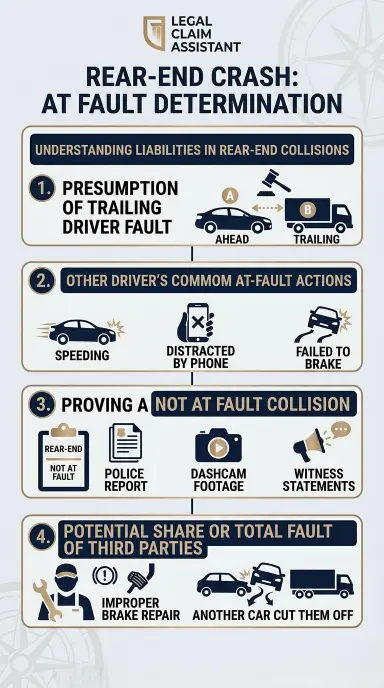
Many people are told that if you were in front, you are always partly to blame. That is not correct. In most rear end crashes, the trailing driver is presumed to be at fault because traffic laws require a safe following distance and control of the vehicle.
A rear end collision may clearly not be your fault when the other driver was speeding, distracted by a phone, following too closely, or failed to brake in time in stop and go traffic. Police reports, dashcam footage, and witness statements often support this fault determination.
There are also situations where another party may share or hold all of the fault. For example, a driver might slam into you because their brakes were improperly repaired, or because another car cut them off. In those cases, a personal injury lawyer can look beyond the simple fact of impact and identify everyone who may owe you compensation through a not at fault collision claim.
Who’s at fault in a rear end collision
Fault in a rear end collision is usually based on negligence. Insurers and courts look at who failed to act like a reasonably careful driver. Common fault factors include speed, attention, traffic signals, weather, and vehicle condition.
The rear driver who hits from behind is often found mostly or entirely at fault. However, fault can be shared. If the lead car stopped suddenly with no brake lights, reversed unexpectedly, or changed lanes and cut off another vehicle with almost no space, liability may be split. Some states use the pure comparative negligence system or other comparative negligence laws that reduce your settlement by any percentage of fault assigned to you.
Because these rules vary by state, it is important to talk with a car collision lawyer or rear end collision attorney who understands local law. Even small changes in assigned fault can have a major impact on your bottom line.
Common injuries from rear end collisions
Rear end collisions often look “minor” from the outside. Bumpers may flex back into shape and airbags may not deploy. Your body experiences a different story. The sudden acceleration and deceleration can cause soft tissue injuries, joint damage, and even brain trauma such as traumatic brain injuries.
Typical injuries include whiplash, neck and back strain, herniated discs, shoulder and knee injuries, concussions, and in more serious cases fractures or spinal cord injuries. People with prior back issues may suffer aggravated pain that still counts as a compensable injury if the crash made it worse.
Symptoms are sometimes delayed. You may feel only stiffness at first and develop severe pain or headaches days later. That is why prompt medical attention and consistent follow up care are so important for both your health and your eventual settlement. Victims should seek immediate medical care, continuing until they reach Maximum Medical Improvement (MMI), to ensure all future medical costs are covered. If you are dealing with lingering pain, our guide on how long does back pain last after a rear end collision can help you understand the medical side.
Medical treatment that strengthens your claim
Medical care serves two roles. It treats your injuries and it documents them. Insurers base settlement offers heavily on detailed medical records, bills, and professional opinions, so gaps in treatment can weaken an otherwise valid case.
Strong treatment patterns typically include a prompt emergency room or urgent care visit within days of the crash, a full exam by a primary care doctor or specialist, diagnostic testing such as X rays or MRIs when appropriate, and consistent follow up with physical therapy, chiropractic care, pain management, or surgery if needed.
Attending all appointments, following medical advice, and keeping personal notes about physical pain levels and limitations help link your condition directly to the collision. This creates a clear timeline from the crash to the treatment and makes it harder for an insurer to argue that you were not really hurt or that something else caused your symptoms.
Average rear end collision settlement: What you need to know
People often search for “average rear end collision settlement” hoping for a simple number. In reality, there is no single average payout that accurately predicts your result. Settlements range from a few thousand dollars for minor soft tissue injuries to six or seven figure results for severe injuries causing permanent disability or emotional and physical distress.
Economic damages are typically easier to calculate because they are based on actual bills and records, while non-economic damages are harder to measure and often require subjective assessments. Insurance companies often use a multiplier method to calculate non-economic damages, applying a number to the economic damages based on injury severity.
Punitive damages may be awarded in cases where the at-fault driver acted recklessly, but they are not common in standard rear-end collision claims.
What you really need to know is that any “average” you see online is usually based on limited or mixed data and may not separate minor injuries from serious lawsuits. The value of your case depends on the unique combination of injury severity, lost income, liability facts, and insurance coverage available.
Instead of relying on a generic figure, it is more useful to look at typical settlement ranges, examples, and the key factors that drive value up or down. Our page on rear end collision settlement examples can help you compare different scenarios to your own situation.
What is the average settlement for rear end collision
When people ask this question, they usually want to know whether it is worth pursuing a rear end accident claim at all. For a low impact crash with minimal treatment and no missed work, settlements may be limited to medical bills, vehicle repairs, and a modest amount for pain and suffering damages.
For minor injuries, settlements typically range from $10,000 to $25,000. Minor/Soft Tissue Injuries, such as whiplash, often settle for $5,000 to $10,000. Moderate injuries, like sprains and fractures, typically settle for $10,000 to $50,000. The average rear-end accident settlement often falls between $10,000 and $50,000, though more serious cases can exceed $100,000. Serious injuries sustained in a rear-end accident, such as spinal cord injuries or traumatic brain injuries, can result in settlements exceeding $100,000.
On average, rear-end collision settlements in the U.S. range from $15,000 to $30,000 when injuries are involved. The average payout for a rear-end collision typically ranges from $2,000 to over $100,000.
Average insurance settlement for rear end collision
An insurance settlement is the amount the at fault driver’s insurer or your own underinsured motorist coverage pays to resolve your claim without going to trial. Adjusters are trained to keep payouts low and may rely on internal software to generate initial offers.
These first offers usually cover only part of your medical bills and a small amount for pain and suffering. They may not fully consider ongoing treatment, future medical costs, long term pain, or the way your injuries affect your daily life. It is common for injured people who negotiate alone to accept less than their claim is worth because they do not have access to the same data, legal standards, or leverage.
If you are dealing with an adjuster and are unsure whether an offer is fair, speaking with a rear end collision attorney or auto collision law firm before signing anything can help you understand the true value of the case.
Average settlement amount for rear end collision
The “average settlement amount for rear end collision” is shaped by several key factors. Medical expenses are usually the starting point. Medical expenses are a major component of rear-end collision settlements, covering immediate and long-term treatment costs. Insurers often look at the total of your past bills and adjust upward for future medical expenses you are likely to need.
Next, they consider lost income from missed work and any reduction in future earning capacity. Lost wages due to missed work from injuries sustained in a rear-end collision can significantly affect the settlement amount. Pain and suffering, emotional distress, and loss of enjoyment of life are added based on the severity and length of your symptoms. Pain and suffering compensation typically ranges from 1.5 to 5 times your economic damages, depending on the severity of your injuries. In rare cases involving extreme negligence, punitive damages may also come into play, although those are more often resolved in lawsuits than in early insurance settlements.
Because no two cases are the same, looking only at an average amount can be misleading. Use it as a loose reference point, not a ceiling. Serious cases often resolve for far more, especially with skilled legal representation.
Average lawsuit settlement for rear end collision
When a rear end accident settlement does not resolve through basic insurance negotiation, your personal injury attorney may file a personal injury lawsuit. Contrary to what many people fear, most lawsuits still settle before trial. The difference is that by then, both sides usually have more information from discovery and expert reports.
Lawsuit settlements often end up higher than early insurance offers, especially in cases with disputed liability or complex injuries. The process takes longer and may involve depositions, independent medical examinations, and court deadlines. However, it also signals to the insurer that you and your lawyer are prepared to prove your case in front of a jury if needed.
If you are wondering how long the process might take, our guide on how long does a rear end collision settlement take explains the common timelines and stages.
Factors that affect rear-end collision settlements
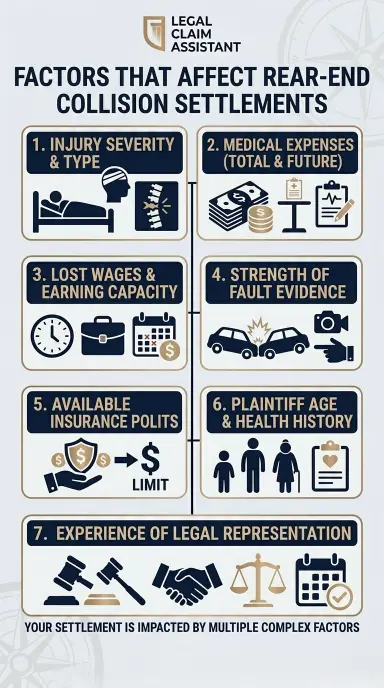
Several core factors tend to shape the value of a rear end accident settlement:
- The severity and type of injuries sustained
- Total medical costs and expected future medical
- How much work you missed and any impact on your long term earning ability
- Strength of evidence showing the other driver was at fault
- Available insurance policy limits and any additional responsible parties
- Your age, health history, and how the injury affects daily activities
- Whether you hired an experienced personal injury lawyer and how close the case is to trial
A minor sprain with a quick recovery and low bills will settle differently than a herniated disc that requires surgery and keeps you from working for months. The same is true if there is video proof of fault versus only conflicting personal stories.
Types of damages in rear-end collision settlements
Rear end collision settlements usually include two main categories of damages, economic and non economic. Economic damages are the measurable financial losses you suffered. These include medical bills, prescription costs, physical therapy, lost wages, reduced earning capacity, property damage to your vehicle, vehicle replacement costs, and any out of pocket costs such as travel to appointments.
Non economic damages refer to intangible losses, such as pain and suffering, emotional distress, anxiety, depression, loss of enjoyment of hobbies or family activities, and reduced quality of life. Pain and suffering compensation is a type of non-economic damage that accounts for physical pain, emotional distress, and the overall impact of the accident on the victim’s quality of life.
These are real harms even though they do not come with invoices or receipts.
In limited cases where the at fault driver acted with extreme recklessness, such as intoxicated driving, punitive damages may also be available through a lawsuit. These are designed to punish and deter, not just to compensate.
Key considerations when filing a rear end accident claim
When you file a claim after a rear end car accident, timing and documentation matter. Most states have strict deadlines, called statutes of limitations, that set how long you have to file a lawsuit. Waiting too long can bar your claim entirely, even if liability is clear.
You should also consider which insurance policies apply. This might include the at fault driver’s liability coverage, your own uninsured or underinsured motorist coverage, medical payments coverage, or personal injury protection depending on your state. A truck collision attorney or auto collision law firm can help untangle coverage in complex multi vehicle or commercial cases.
Finally, think about your long term needs, not just immediate bills. If you rush to settle before your treatment plan is clear, you may sign away the right to recover compensation for future medical costs that you will still need to pay.
Questions to ask a rear end collision lawyer
When you speak with a rear end collision lawyer, it helps to come prepared. Consider asking:
- How many rear end collision cases have you handled that are similar to mine
- What range of settlement outcomes do you see for cases with my type of injuries
- How do you charge fees, and do I owe anything if we do not win
- How will you investigate fault and gather evidence in my case
- How long do you expect my case to take based on your experience
- How involved will I need to be, and how often will you update me
Clear answers to these questions can help you decide whether the attorney is the right fit and whether you feel comfortable trusting them with your case.

Mistakes that can reduce your settlement
Certain common mistakes can significantly reduce the value of an otherwise strong rear end collision claim. Delaying medical care or missing appointments makes it easier for insurers to argue that you were not truly injured or that something else caused your pain.
Giving a recorded statement to the other driver’s insurance company without legal advice can also be risky. Adjusters may use your words out of context later. Posting about the crash or your injuries on social media, even casual photos of you trying to live normally, can be misinterpreted and used against you.
Settling too quickly, before you know the full extent of your injuries and future medical needs, is another major pitfall. Once you sign a release, you typically cannot go back for more money, even if your condition worsens.
What to do immediately after being rear-ended
Right after a rear end collision, your first priority is safety and medical care. Move to a safe location if you can, call 911 if anyone is hurt, and accept medical evaluation at the scene. Even if you feel “fine,” adrenaline can mask significant injuries.
Checking for significant injuries and seeking immediate medical attention for anyone hurt is critical after a rear-end collision.
Next, collect information. Get the other driver’s name, contact details, license number, and insurance information. Take photos of both vehicles, the scene, skid marks, and any visible injuries. If there are witnesses, ask for their contact details as well.
Documenting the accident scene is vital for supporting your insurance claim and establishing fault. Filing a police report after a rear-end collision is crucial as it helps establish fault and supports insurance claims.
Collecting witness contact information can be beneficial, as their statements can support your case if there are disputes over fault or damages.
Taking photos of vehicle damage, license plates, road conditions, traffic signs, and any visible injuries can serve as strong evidence when dealing with insurance companies.
Report the crash to the police and to your insurance company. Notifying your insurance company as soon as possible ensures your claim is processed efficiently. For a more detailed checklist, you can review our guide on what to do after a rear end collision or the broader steps in what to do after a car collision.
Keeping all medical records and receipts is essential for proving the extent of your injuries after a rear-end collision.
Should you accept a rear end collision settlement?
Whether you should accept a settlement depends on your medical status, financial needs, and the quality of the offer. Before saying yes, ask yourself if your treatment is complete, if your doctor has discussed any long term effects or future procedures, and whether all your bills, vehicle damage, and lost wages are included in the offer.
Consider also the non economic side. Does the amount reasonably reflect the physical pain, emotional and physical distress, and stress you have faced since the crash. If the offer feels low or rushed, there is usually a reason, and it may be wise to pause and get legal advice.
Once you accept and sign, the claim is usually final. You will not be able to reopen it if new symptoms appear or if you learn that similar cases in your area settled for more.
Once a settlement is agreed upon, a Settlement and Release Agreement is signed, releasing the at-fault party from future liability in exchange for payment.
How to calculate potential compensation
Calculating potential compensation for a rear end collision involves adding up your economic losses and then assigning a value to your non economic damages. Start with medical bills, therapy costs, prescription expenses, and any related travel. Add lost wages and any documented reduction in earning capacity.
Non economic damages are more subjective. Lawyers and insurers may use multipliers of your medical costs, daily rate methods, or comparisons to results in similar local cases. The more serious and long lasting your pain and limitations, the higher this part of the settlement tends to be.
A local personal injury attorney can give you a more precise estimate based on verdicts and settlements in your area. Our team at Legal Claim Assistant can connect you with such an attorney for a personalized review.
The role of insurance companies in rear end collision claims
Insurance companies control most of the money involved in rear end collision claims. Their role is to investigate, evaluate, and either settle or defend against your claim. Their financial incentive is to limit payouts, not to maximize your recovery.
Adjusters may appear friendly, but their questions often aim to minimize fault, challenge the extent of your injuries, or find reasons to reduce or deny coverage. They may rely on internal guidelines or software rather than the full reality of your experience.
Insurance companies often offer lower payouts to victims who do not have legal representation, assuming they lack the experience to negotiate a fair settlement.
Having an attorney involved changes that dynamic. Insurers know that represented claimants are less likely to accept low offers and are more prepared to pursue litigation if needed. This is one reason why people with lawyers often receive higher net settlements even after legal fees.
When to file a lawsuit or claim for a rear end collision
You should file an insurance claim as soon as reasonably possible after the collision. This preserves evidence and starts the process of getting your medical bills and property damage addressed. Many people contact a lawyer before or shortly after submitting the claim to avoid early missteps.
A personal injury lawsuit is usually considered later, if settlement negotiations stall or if the insurer disputes fault or the seriousness of your injuries. Your attorney will watch the statute of limitations and file suit in time to protect your rights if a fair settlement cannot be reached.
Filing a lawsuit does not mean you are guaranteed to go to trial. It often becomes a structured way to keep negotiations moving while gathering more evidence.
How Legal Claim Assistant can connect you with the right rear end collision lawyer
Legal Claim Assistant exists to help injured people understand their rights and connect with qualified attorneys for a free case review. Rear end collisions may look simple on the surface, but as you have seen, fault rules, medical issues, and insurance tactics can quickly complicate your claim.
When you reach out to us, we gather basic details about your crash, injuries, and treatment. We then match you with a personal injury lawyer or auto collision law firm that handles rear end collisions in your state and has experience with cases like yours. The consultation is free and there is no obligation to move forward.
If you decide to hire the attorney, they typically work on a contingency fee, which means you pay nothing upfront and only pay legal fees if they recover money for you. This allows you to focus on healing while your legal team focuses on securing fair compensation for your rear end collision.
You Deserve Justice. Let Us Help.
Speak with a trusted Collsions lawyer who will stand by your side, protect your rights, and fight for the compensation you deserve.
No Win, No Fee. Let the Best Collsions lawyers Fight for your Compensation!

Under 1 Minute

100% Free

Expert-Reviewed

Private & Secure
© 2025 Legal Claim Assistant. All Rights Reserved.
Terms of Service | Privacy Policy | Contact Us | Marketing Partners
Related Article

Should I Get a Lawyer After a Drunk Driving Accident?

When Does a Drunk Driving Accident Lawsuit Make Sense?
Share this article:


